'A place marked for drama'
Hi everyone, I realise I haven’t posted in a while, actually this has been the longest pause since biblonia began just under 10 years ago. I have returned from my honeymoon in Mexico and, as I thank you for your patience, I’ve got a new post ready, inspired, predictably, by my recent travels.
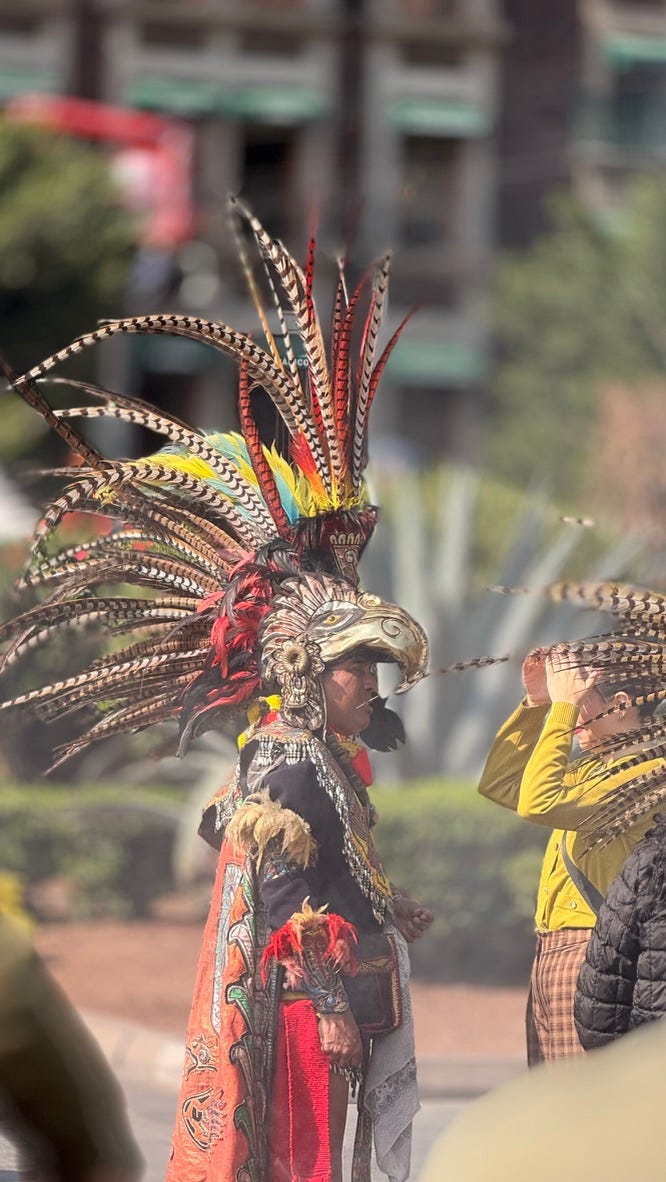
As my wife and I travelled from London to Mexico City, Teotihuacan, then Oaxaca and the Yucatan coast, I’ve been reading Hugh Thomas’ Conquest: Montezuma, Cortés and the Fall of Old Mexico and Juan Villoro’s Horizontal Vertigo: A City Called Mexico, the former in order to understand how it all started over there (arguably all), and the latter to get a sense of modern Mexico as represented, partially or fully, by the soul and recent history of Mexico City and its chilangos. Both were phenomenal reads.
The thing that struck me the most in CDMX (Ciudad de Mexico), and indeed elsewhere in the country, is the proliferation of resources, which sounds better than saying ‘abundance of things’. Villoro points out:
“If someone finds a taco restaurant with lots of empty tables, they suspect the tacos served there are filled with dog meat. Anything not overflowing is a failure. That explains why the airport is filled up with a compact mass of visitors: a chilango only knows he’s arrived if there are ten relatives waiting for him.”
And elsewhere:
“The old Federal District and its outlying villages (the Great Annexations) boast the most intense exploratory traffic on the planet. More than five million cars take to the road, not in search of a specific course but to see if it’s at all possible to move forward.”
There’s a different marketplace concept at work there, “a city where it’s entirely possible that the person threatening you with a knife may either kill you or try to sell it to you.”
But perhaps the most remarkable is the proliferation of staff. As Villoro notes, “Mexico has produced a social function I would dare to say cannot be exported: the position of “manager.” This is not a boss and even less a specialist. It’s someone who appears behind a counter to represent the vaguest form of authority: he complicates life without being responsible for anything”
From restaurants to hotels to shops and ticket offices, the managers seem to be an endless cohort of intermediaries, and they are not into making things easier: “Incompetent to the point of proselytism, the manager convinces you that there is only one thing worse than problems: trying to solve them.”
I had to get used really quickly to drinking only bottled water. This is hardly novel. “On this planet, there is life thanks to water. In Mexico, drinking water can cost you your life”.
Before I get to the food, there is the driving. Villoro again: “Mexican drivers combine the clumsiness of Italian drivers, the sadism of French drivers, and the ill humor typical of the Shah of Persia’s relatives.” Traffic attains apocalyptic splendor on the avenues that lead out of the city. It’s perhaps the hope of abandoning the horror of thousands of drivers subjecting themselves to the purgatory of going to paradise in slow motion.”
To say that the Mexicans cook and enjoy food is an understatement, but what do I know, I only spent three weeks there. But I had the best food of my life - and I would never take this ranking lightly. No wonder the Mexican traditional cuisine is the only one to have made it on the UNESCO ICH list. And, one word of advice: it has nothing to do with what Mexican restaurants outside Mexico are like. I will not say more on this occasion… but the tamales, the mole, the Oaxacan tlayudas, the Taco de ojo (made with cow eyes), even the salts (maguey worm, grasshopper-based) evoke a different galaxy rather than a different continent.
I’ll save the rest, and the events of 1519-1521 for a future post. Until next time.


