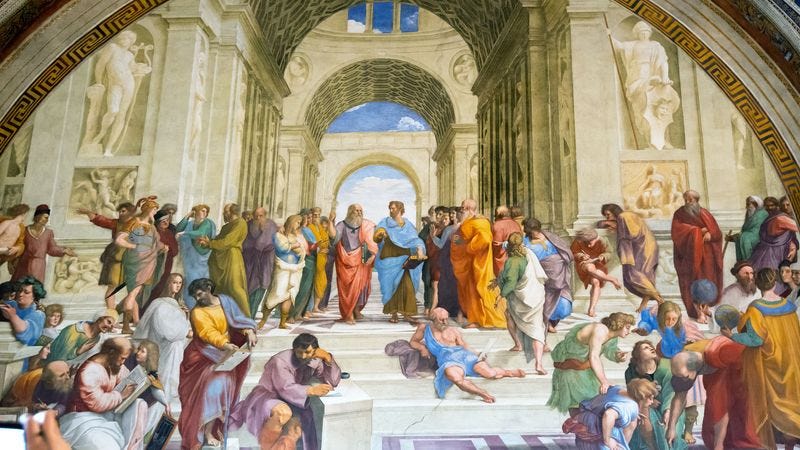
It’s often forgotten how richly profuse in ideas and intellectual schools the last third of the first Mediterranean millenium BC was. Following Socrates and Plato, the Cynics, the Stoics, the Epicurians, the Pyrrhonist sceptics and a tonne of other schools that history has been less kind in preserving.
It’s as if the bag of intellectual experimentation, closed for millenia, had suddently popped open. Of course, that’s silly. Once philosophy graduated into a mindset during the first millenium BC, there could be no stopping to bringing more of it. Who doesn’t want another toy? The funny thing is that that generation of philosophy didn’t produce any communal or societal benefits immediately. Socrates asked the wrong questions and was put to death. The Stoics and the Epicurians emphasized personal accountability in life, with less focus on ways of communal living, building society or the state. In fact, the Greek cities, the Roman state, and communities in general, remained virtually unaffected by all this proliferation of ideas. Later, Marcus Aurelius made his reputation as a Stoic emperor, but that was the exception, rather than the rule.
You might say that ancient philosophy failed to scale. Like the best restaurants, it was fated to remain small-scale, boutiqued, unfranchised.
Traditions emerged, coalitions were made (such as that between Neoplatonism and Christianity, or Aristotelianism and Islam), scholarly transmission lines were assured via manuscripts and fervent copying of texts. But none of the foundational schools achieved any kind of large-scale impact. In the West, most of these schools were rediscovered under the badge of Renaissance humanism, before being absorbed into modern projects (think scepticism and Descartes).
There is newfound interest these days in some of these, especially in Stoicism. I’ve been quite interested lately in the legacy of the Pyrrhonians like Sextus Empiricus. But that only goes to show that these foundational schools of thought, while sowing the seeds for all modern ideas and intellectual traditions, remained precisely that - seminal and small-scale. And perhaps that was the unintended virtue of the whole project.


