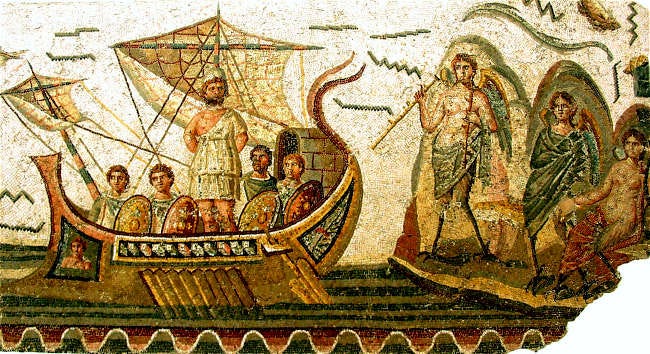
Between the road and the room
Homer’s Odyssey endures because the poet resists making easy choices
I confess that I return to the Odyssey every summer, and every summer it gives back something new. That is the mark of great storytelling, I think, not repetition, but renewal.
The poem’s central tension is not a problem to be solved but a condition to be inhabited.
Odysseus is both the man who longs to see his wife, son, and father again, and the man whose intelligence seems most alive when it is under pressure, exposed to peril, improvising in motion.
Homer makes both desires legitimate. Gregory Nagy has argued that the Odyssey is the definitive poem of heroic homecoming, and that is exactly right, but homecoming in this poem is never simple, never fully settled, never allowed to become a neat ending.
Odysseus is always being pulled toward Ithaca and away from it at the same time.
That is why the poem feels so human and is able to speak to us again and again across millenia. Home is not merely a destination. It is a claim made by memory, love, and obligation. But wandering has its own seductions.
Emily Wilson has shown that the Odyssey is a richly layered poem in which Odysseus’ long homecoming is only part of the story, since the poem also keeps alive the pull of wandering, risk, and desire. That is exactly the point. Homer does not choose between the two. He lets them remain in tension. He lets adventure sparkle, but he also lets us feel the gravity of the house, the bed, the familiar face, the life that waits to be resumed rather than discovered.
Dante understood the darker side of that appetite. In the Inferno, Ulysses becomes the man who cannot stop, the voyager who turns homecoming into another departure and then another. Lino Pertile describes Dante’s Ulysses as a profoundly restless character whose ceaseless quest for knowledge, novelty, and happiness ends not in fulfilment but in death. That is the severe, brilliant counterpoint to Homer. Homer’s Odysseus is not damned for his mobility, but he is not healed by home either.
The poem keeps the wound open.
And perhaps that is why it endures. It knows, or rather discovers, that human beings are divided creatures. We want the road and the room, the surprise and the familiar face, the far horizon and the lamp in the house. We want to become experienced and to be known. Odysseus is never fully satisfied because satisfaction would end the story, and Homer is too intelligent, too generous, too ‘Ulyssean’ for that.
So he keeps sailing, even when he is standing still, and even in Ithaca he seems already to be elsewhere.


