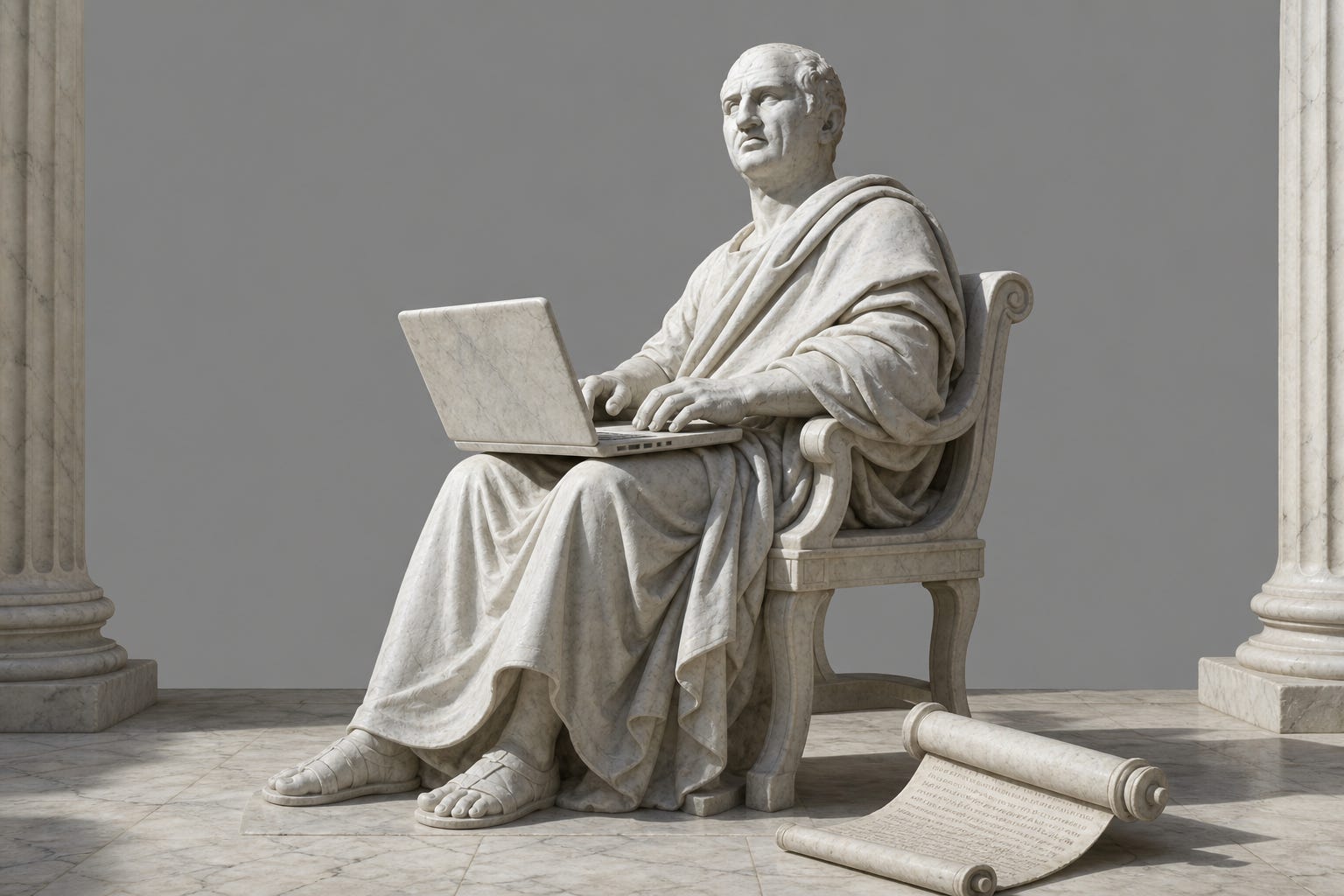
Cicero and AI
The five canons of rhetoric are beyond the grasp of genAI
What would the greatest orator of the ancient world make of a technology that produces fluent, well-structured prose in seconds?
Rhetoric, for Cicero, was not a trick or a decoration, and certainly not a simulacrum. It was the central mode of civic life.
In De Oratore and Orator, he argued that roughly half of all human communication is rhetorical, oriented toward persuasion, toward moving an audience to act or believe. The other half is poetic: not persuasion, but recognition, the marvelling at the human condition that only art and poetry make possible. These two modes are distinct.
Generative AI touches one far more than the other, though it can mimic both. And within rhetoric itself, the contact is uneven.
Cicero organised the rhetorical process into five canons. Inventio is the discovery of arguments. Dispositio is their arrangement. Elocutio is the choice of language. Memoria is the internalisation of the speech. Pronuntiatio is its live delivery. Each canon is a discipline in its own right.
Of the five, only elocutio falls almost entirely within what gen AI can do. Given raw material, it can dress it fluently, vary register, shift tone. This is not nothing, clearly. But it is the least intellectually demanding of the five canons, the surface rather than the structure.
Inventio is more contested, I’d say. AI can scan, retrieve, and aggregate. What it cannot do is decide what matters. Relevance is a judgment, not computation, or statistical inference, and AI relevance is 100% parasitical on prior human judgement. Dispositio is even more dependent on human strategic sense. What to foreground, what to concede, what to withhold. These decisions are contextual, relational, and… political in the deepest sense.
Memoria and pronuntiatio are another matter entirely. They are performative and embodied. Pronuntiatio, the physical command of voice, pause, eye contact, presence, is not reducible to text-to-speech or voice AI. Cicero devoted more attention to delivery than to any other canon, because he understood that an argument not performed is an argument not made.


