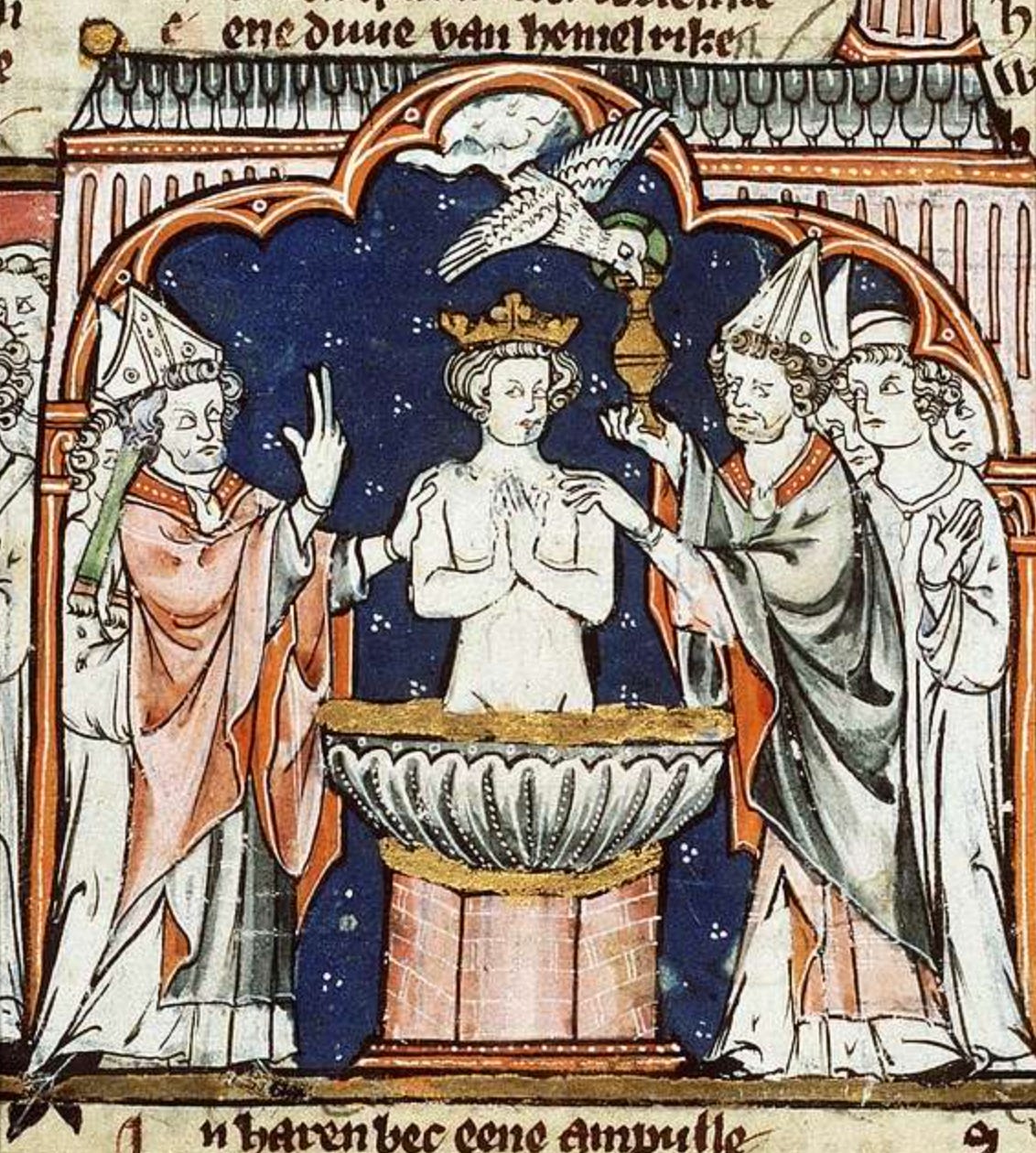
Clovis in a vacuum
Julius Caesar had the strange habit of watching himself think.
His account of the Gallic Wars, De Bello Gallico, was written in the third person: “Caesar did this, Caesar decided that”, as if he were simultaneously the general and the historian, the actor and the critic.
It is a remarkable exercise in self-narration, the tragic leader constructing his own myth in real time.
Clovis had no such luxury, or perhaps no such vanity. He left no memoir.
And yet the questions he raises, about power, legitimacy, and the art of ruling in a world dissolving around him, may be more instructive than anything Caesar wrote. Classical historians gasp in terror at these words.
Clovis was born around 466 AD, son of the Frankish chieftain Childeric I. He inherited a small, rough territory around Tournai, in today’s Belgium, at the time a backwater on the fringes of a Roman Empire already in its death rattle.
By the time he died in 511, he had assembled something that would eventually become France. How was that possible?
Bishop Gregory of Tours, writing his Historia Francorum roughly sixty years after Clovis died, is our primary window. He describes a man who was ruthless and canny, capable of strategic marriages, calculated conversions, and the elimination of rivals with a precision that bordered on the theatrical.
When Clovis defeated Syagrius, the last Roman military governor in the West, at Soissons in 486, he won more than a battle and what followed was more than conquest: it was, I would say, absorption, as Clovis folded surviving Roman administrative structures into his own emerging authority rather than dismantling them.
Gregory records Archbishop Remigius telling Clovis at his baptism around 496: “Burn what you have worshipped, and worship what you have burned.”
The historian Patrick Geary has described Clovis’s conversion to orthodox Christianity as something closer to a political technology than a spiritual event, as it aligned him with the episcopal networks of the Gallo-Roman church, the most durable institutional structure surviving the imperial collapse, while isolating his Arian, non-orthodox rivals.
I offer a further complicatIon. What we usually think of as the “barbarian takeover” of that period was, in many respects, a Roman process. Figures like Clovis operated not against Roman structures but through their residual logic. So was Clovis an innovator or an inheritor? Was he seizing power, or was power simply finding its most competent available vessel?
And there are so many more questions. Did Clovis understand what he was building, or was he simply reacting faster than everyone else? Gregory himself opens his history with the admission that “a great many things keep happening, some good, some bad”, a deceptively simple observation about a world in flux that Clovis, of all the figures of his age, seemed to navigate with the least hesitation.
So next time I hear about leading in uncertainty, navigating the unknown, or about polycrisis, omnicrisis, or BANI-VUCA worlds, I think of millenium-old Clovis, who (consultants gasp!) knew a thing or two about these matters.


