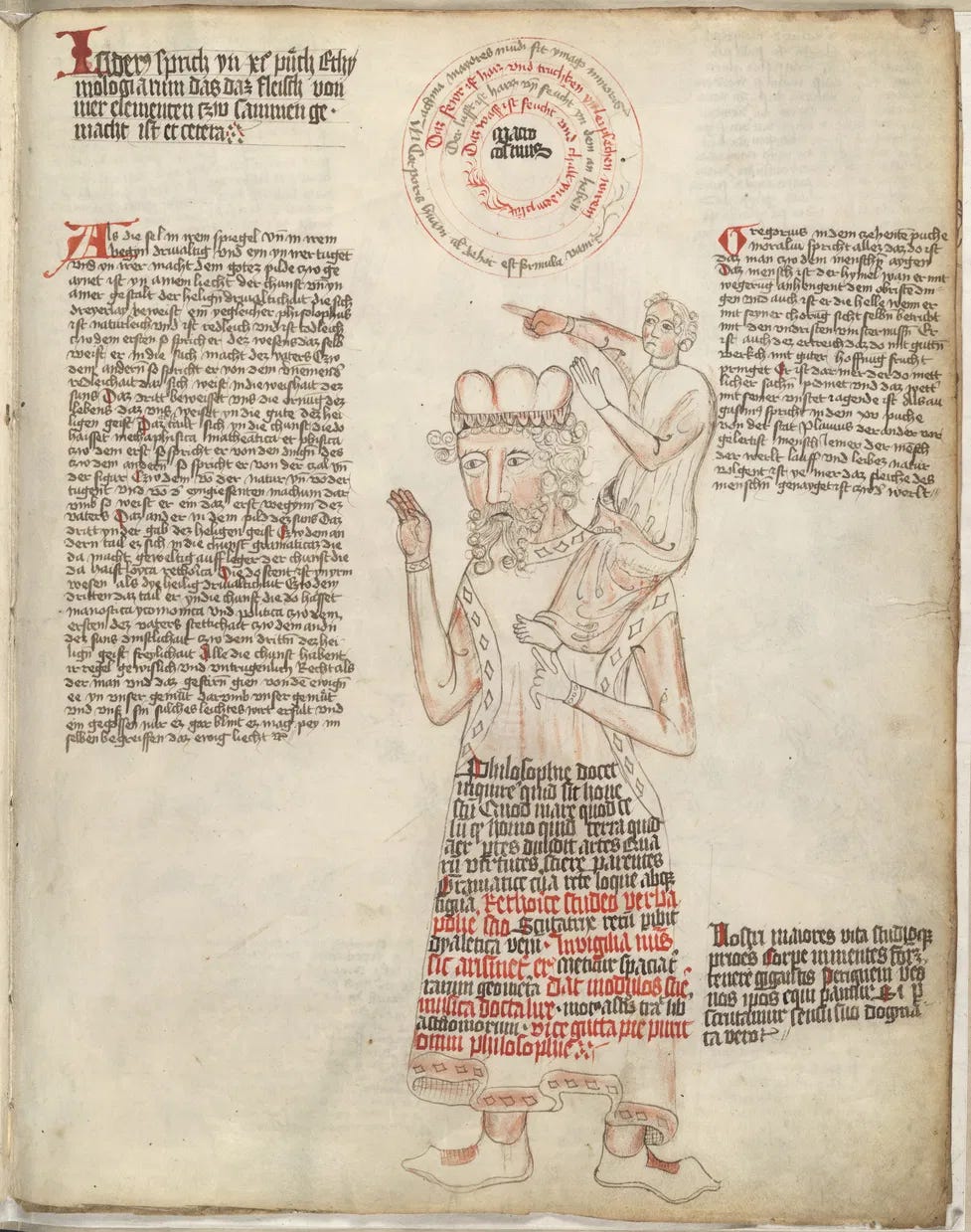
Giant egos standing on shoulders of giants
When the twelfth-century philosopher Bernard of Chartres wrote the famous words, “We are like dwarfs standing on the shoulders of giants,” he drew attention to two things at once. One is that it is the generations preceding our own and our age that enable us to see farther and better. Modesty, humility, and recognition of inherited authority. We build on the work of those who came before us. So far, so good.
The other thing his words implied was the opposite of humilitas. We may be dwarfs, but we are dwarfs with giant egos, especially in the twelfth century. Think of Thomas Becket against King Henry II, or Peter Abelard challenging William of Champeaux, while the examples, to paraphrase razor-sharp Ockham, “non sunt multiplicanda praeter necessitatem” (“ought not to be multiplied beyond necessity”).
To a certain extent, the twelfth century could easily be nicknamed the Age of Egos. Thinker confronted thinker, monarch opposed monarch — pope and emperor locked in endless conflict — while theologians tested the limits of kingship, as Becket himself discovered at the cost of his life (though hardly the only one). The intellectual life of the period thrived on contradiction: an oscillation between deference and defiance, between the humility expected of faith and the assertiveness demanded by reason.
At the heart of medieval scholarship lay a paradox that would never be fully resolved. How could one reconcile the Christian demand for spiritual humility with the intellectual hunger to define, explain, and sometimes dominate through knowledge? Almost every medieval author began with the humility topos: elaborate apologies for writing at all, homage to the greater minds who preceded them, and declarations that their words were of no worth compared to those of Aristotle or the Church Fathers. And yet, the moment the preface ended, they wrote with absolute authority, claiming to interpret the cosmos, the soul, and the divine order itself. The pose of modesty was often the rhetorical gateway to an act of towering self-assertion.
This ancient tension hasn’t disappeared with the Middle Ages. Modern culture plays the same game in different language. We claim to “agree to disagree” and to prize humility in discourse, but rarely do we inhabit disagreement deeply or change our convictions because of it.
If the medieval scholar cloaked ego in piety, today we disguise it with civility. The contradiction survives, in subtler form: our deference to the giants of the past coexists with an almost irresistible need to believe we see farther than they ever could.


