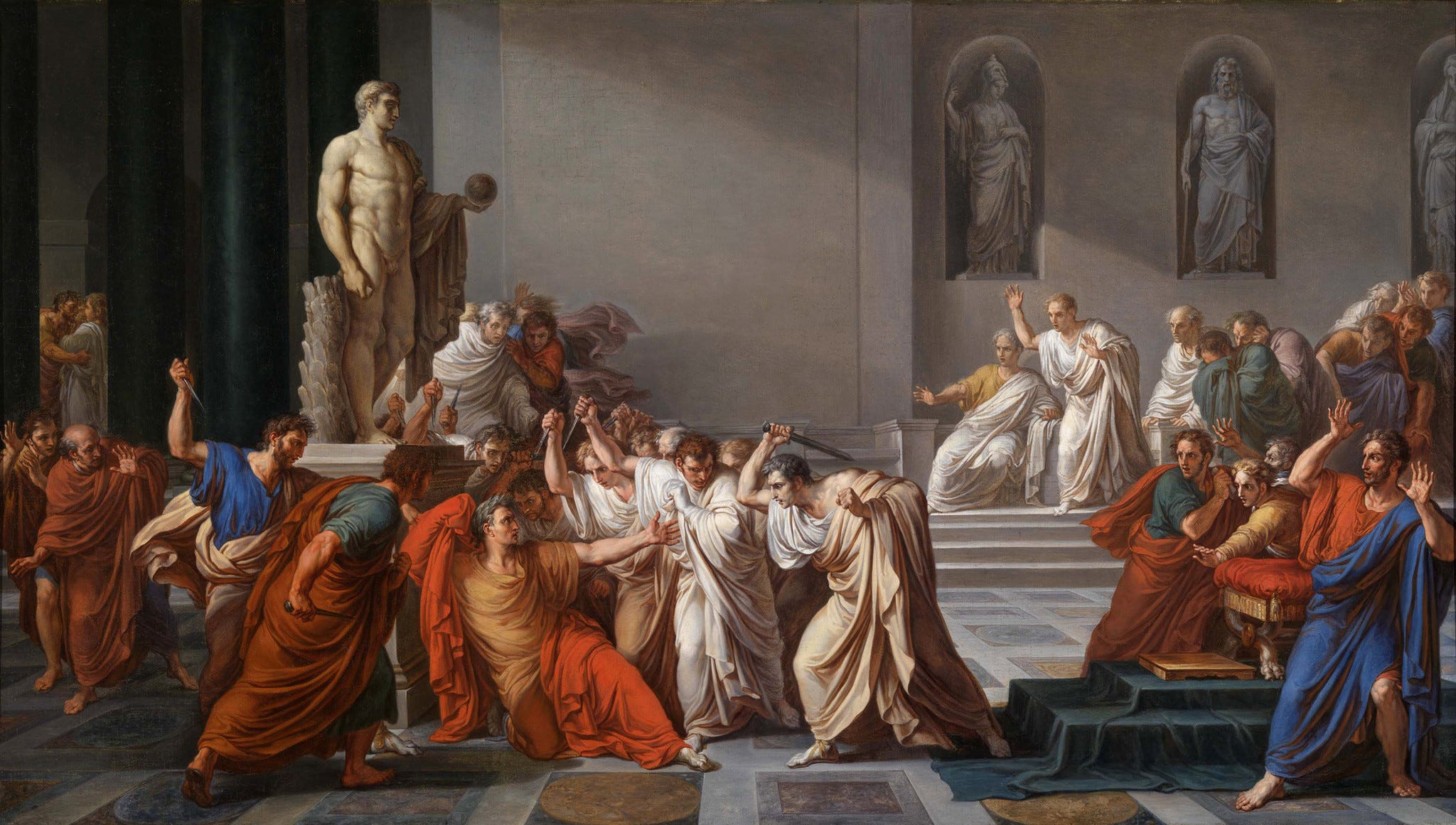
History and the onus reversal

“History is written by the winners” is an evolutionary statement.
Every organism alive carries within it the encoded record of what worked, a compressed archive of successful adaptations. The losers left no descendants, no texts, no traditions.
To recover their story is a legitimate intellectual and moral act, but an honest one requires acknowledging what is actually being done: choosing a value, such as pluralism, justice, inclusion, over the grain of biological logic.
The same logic governed attitudes toward novelty for most of human history. What persists has been tested. What is untested carries unknown costs. The boring old mushroom always wins over the exciting new toadstool.
The Greeks had a word, neōterismos, for political innovation, and it was not a compliment. From antiquity through the medieval world (the medieval Latin res novae, literally ‘new things’, meant revolt or political change) the burden of proof lay entirely with the new: demonstrate your value, or yield to what endures. Rational risk management, written into the body (politic).
That burden has now inverted. In every domain, be it technology, medicine, business or culture, novelty is presumptively valuable and the status quo must justify itself.
This inversion coincides with something else: in our culture, biology features less and less in how we understand ourselves. Our intelligence is increasingly conceived as computational, our social life as networked, our bodies as peripheral to who we are. The more we abstract ourselves from our embodied, evolved nature, the more natural it feels to take large risks in pursuit of progress, because the ancient calculus that made caution rational operates below the threshold of awareness.
This is worth sitting with rather than judging.
Progress may be defined precisely as the wager that novelty now serves survival better than caution does. For most of biological and human history, though, that wager would have been refused on instinct.


