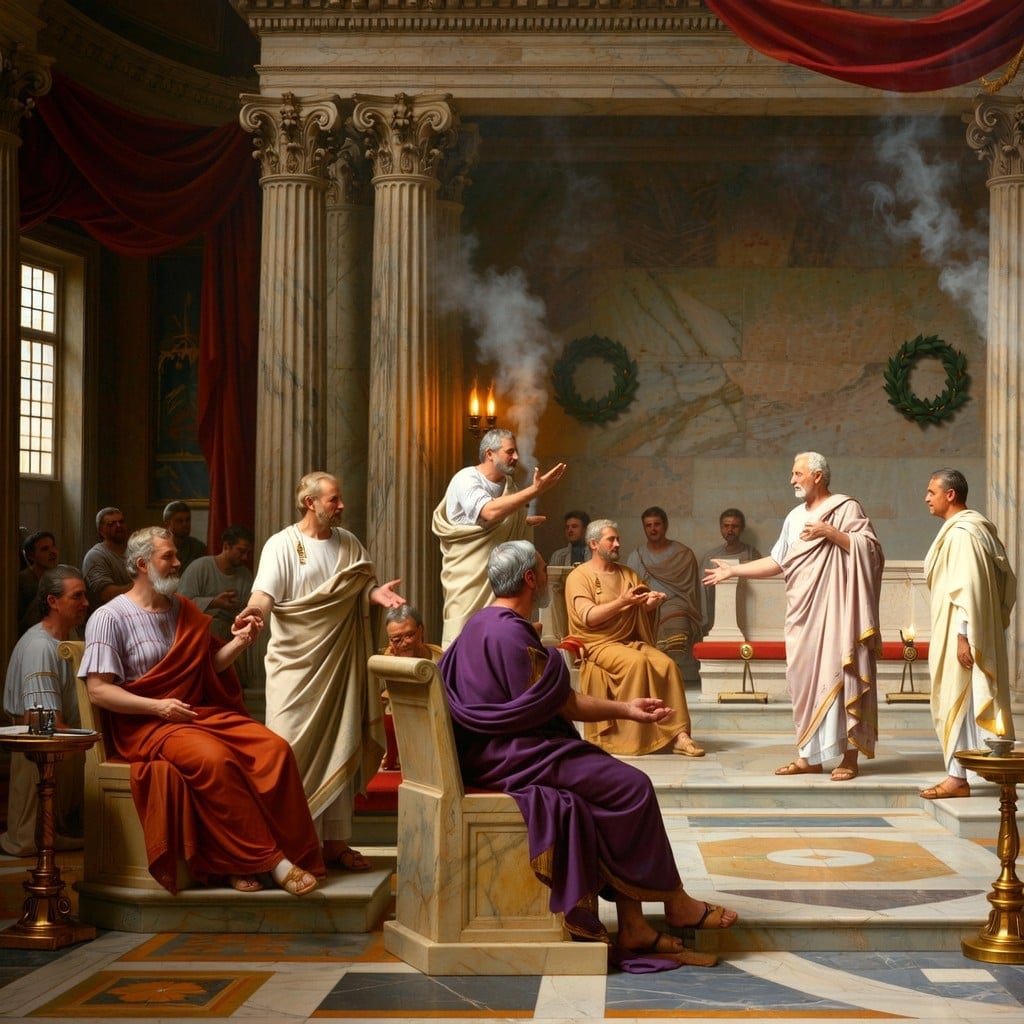
How European disagreement turned out to be a strength rather than a weakness
The ancient Mediterranean was a graveyard of political experiments.
Greek cities cycled through regimes with startling speed, moving from kingship to aristocracy to tyranny to democracy and back again, often within a century or two; Athenian democracy in its classical form lasted roughly 140 years, from the reforms of Ephialtes and Pericles in the mid‑5th century to its eclipse under Macedonian control in the late 4th century BC, a blink against later imperial chronologies.
Alexander’s world empire, consolidated by his father Philip II, dissolved almost as soon as he died in 323 BC, fragmented among rivals within a generation.
The Roman Republic managed around five centuries before yielding to one‑man rule; the unified Roman Empire in the West endured for a shorter span, barely five hundred years, and its political form morphed repeatedly on the way.
None of this matches the longue durée of Chinese dynastic cycles, the civilisational continuities of the subcontinent, or even the Ottomans’ six centuries of imperial rule.
Cicero, writing in the last age of the Republic, and historians such as Sallust and Livy, framed Rome’s descent into civil war as a story of moral decay, constitutional erosion, and elite greed, a tragic departure from an imagined republican norm. Tacitus, looking back from the early Empire, saw senatorial freedom suffocated by imperial power, while others, such as Appian, traced the violence to deep social and economic tensions.
What none of them could quite see was that this chronic instability, this habit of contesting institutions, offices, and ideas, was itself becoming a structural feature of what we call Europe or the West: a culture in which legitimacy was always negotiable and no settlement undisputed.
The Middle Ages did not break with this pattern so much as translate it. I’ve written more about the medieval context here:
The age of contestation
One of the most enduring myths about the middle ages is that it was an age of speech supression, the lowest point in Europe's history of freedom of thought. That theology took over all other areas of scientifi…
The Investiture Controversy pitted pope against emperor over who could appoint bishops, and its eventual compromise at Worms in 1122 formalised a division between spiritual and temporal authority that neither side fully controlled, unintentionally empowering local princes and urban communes within the Holy Roman Empire.
Across Latin Christendom, royal power, episcopal authority, noble privilege, urban liberties and customary law pulled against one another, producing what Susan Reynolds has described as a densely plural, overlapping order of jurisdictions, rather than a tidy feudal pyramid.
This same fragmentation opened spaces for the university scholar, the mendicant preacher, the urban jurist, the merchant guild: social roles in which individual conscience, judgement and initiative mattered, and where the language of rights and privileges began to attach to persons and groups, not just to offices.
Modern scholars have tried to capture this long arc as a story in which a predisposition to dispute, whether over theology, over sovereignty, over economic practice, made Europe good at living with, and eventually harnessing, disagreement.
In his book The Enlightened Economy, Joel Mokyr speaks of an “industrial Enlightenment” nourished by the Republic of Letters, a trans‑European community held together less by obedience than by argument and critique; in his account, innovation flourished where no single authority could successfully shut debate down.
A predisposition to dispute, whether over theology, over sovereignty, over economic practice, made Europe good at living with, and eventually harnessing, disagreement.
What looks, in Cicero’s Rome or in the bitter polemics of late medieval Christendom, like pure dysfunction appears over a longer timescale as a distinctive ecology: unstable, frequently violent, but unusually generative of new institutions, scientific practices, and political vocabularies.
Contestation culture is the West’s weakness because it prevents stable closure.
But it is its strength as it keeps the argument, and thus the capacity for change, permanently open.


