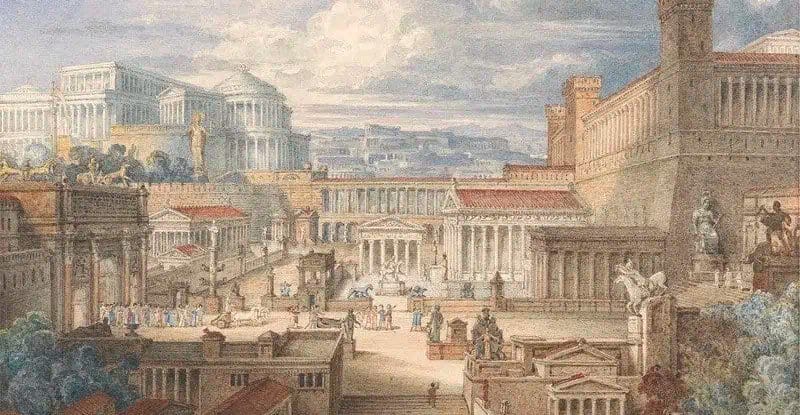
How Rome built community
“Building community” is one of the great buzzwords of our age, spoken in boardrooms, on leadership retreats, across Linkedin feeds.
But the challenge it describes is ancient.
Every civilization must solve the same problem: how do you organize populations, scattered, diverse, self-interested, into something coherent, durable, and culturally aligned? The complexities of the ancient Roman response to this challenge are worth pointing out.
Rome began, as all ancient societies did, with the domus, the household. Not just a family in the modern sense, but a legal and moral unit under the absolute authority of the paterfamilias, the senior male. Slaves, freedmen, clients, and kin were bound into a single structure of obligation and protection. Community as hierarchy, all too familiar. And it worked because everyone knew their position.
Above the household sat the client-patron relationship, the clientela. A patron offered legal protection, financial support, and social leverage. A client offered loyalty, votes, labor, and presence, showing up at the patron’s door each morning in a ritual greeting called the salutatio. Not so much friendship as client-centricity, the quid pro quo of small scale networks. Structured mutual dependency, scaled across the entire city and later Empire provinces.
Rome was also full of collegia, voluntary associations organized around trade, religion, burial, or neighborhood, the common ancestor of all medieval guilds, trade unions and non-profits. A burial club, known as collegium funeraticium, ensured that even the poor received a proper funeral. These were the smallest solidarities. They gave people a name, a place at a table, a shared ritual.
But perhaps Rome’s most radical invention was Roman citizenship.
Gradually extended across Italy and eventually the empire, it was a legal status that created belonging across enormous distances. You could be in Hispania or Syria and be Roman, not culturally identical, but legally equivalent. Citizenship abstracted community from geography.
And that takes us to religion. Roman public religion was not primarily about belief. It was about participation. The ritual calendar synchronized Roman life, pulling populations into shared rhythmic experience. The ludi, the great public games, were as much about entertainment as they were civic events, moments where the population assembled as a body and recognized itself as Roman. All post-Roman schismatic movements, from the Late Antique Christian struggles between orthodoxy and heresy to post-Reformation early modern Wars of Religion were possible because religious participation was already there and taken for granted.
Finally, law. Roman law then unified what religion and custom could not, taking everything up the scale of complexity and organisation. It created legible, transferable rules for property, contract, family, and punishment across wildly different cultures. Law was the infrastructure of community at scale. It replaced the need for shared ancestry or shared gods with shared procedure. And it set the scene for the rest of the show.


