Is it really an error?
Challenging the idea that getting an idea wrong is wrong
One common mistake is to mistake a wrong idea for the wrong idea. To disparage the (distant) past for getting things wrong. In fact, to get stuck on ‘they got it all backwards’ and miss the context and the bigger picture.
It can be shown that for every idea that the ancients got wrong, from medicine to astronomy, from psychology to epidemiology, there was a long tail of benefits in the long run. If only we looked at it all as a system and over the longue durée, that is over time.
The medieval alchemist was labouring under wrong priors and wrong goals, but without her miguided toil we wouldn’t have discovered the properties of metals, thermodynamics, bref we wouldn’t have gotten to chemistry.
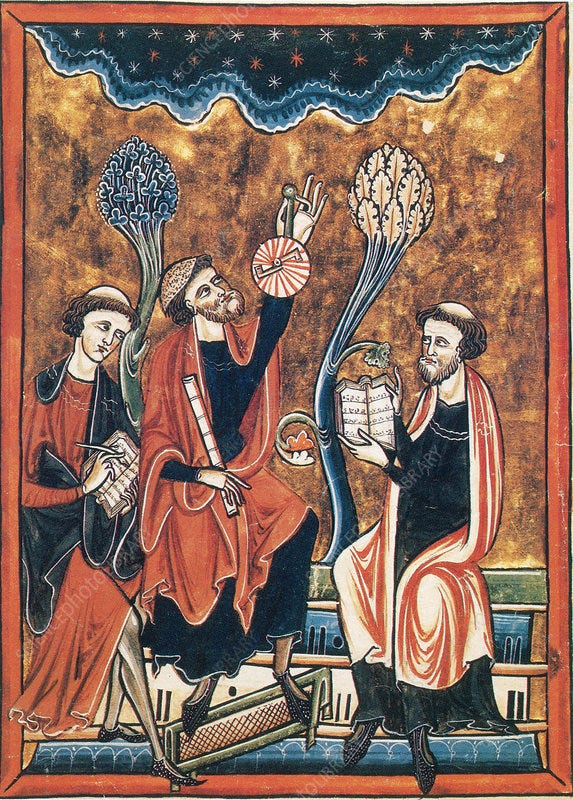
The endless calculations astronomers made under the geocentric model, basically 1000% incorrect from a modern astrophysical perspective, made Copernicus, Galileo, Kepler and Newton’s ideas possible. The basis was incorrect, but it was a huge basis nonetheless, a debt that remains silently unpaid.
The point can be broadened with little risk. Mario Livio’s book Brilliant Blunders examined the colossal mistakes made by scientists such as Darwin, Lord Kelvin, Linus Pauling, Fred Hoyle, and Albert Einstein that ultimately advanced human understanding of life and the universe. Similarly, Tim James (Accidental), Royston Roberts (Serendipity) and Simon Levay (When science goes wrong) looked at unintentional breakthroughs, fortuitous accidents and failures that produced significant knowledge when set against a larger backdrop and a longer timeline.
We marvel far too often and too much at how the ancients and the medievals incorrectly believed that the Sun revolved around the Earth and far too rarely and too little at how indebted we still are to them for starting the conversation and laying foundations.
In what is now a famous trope, yet more often quoted than practised across domains, the 12th-century English polymath John of Salisbury noted about his contemporary scholar Bernard of Chartres, that (worth giving in full), nos esse quasi nanos, gigantium humeris insidentes, ut possimus plura eis et remotiora videre, non utique proprii visus acumine, aut eminentia corporis, sed quia in altum subvehimur et extollimur magnitudine gigantea: “he used to say that we are like dwarfs perched on the shoulders of giants, so that we can see more and farther than they could, not by any keenness of our own sight or height of body, but because we are lifted up and borne aloft by their giant size” (Metalogicon, chapter 4).


