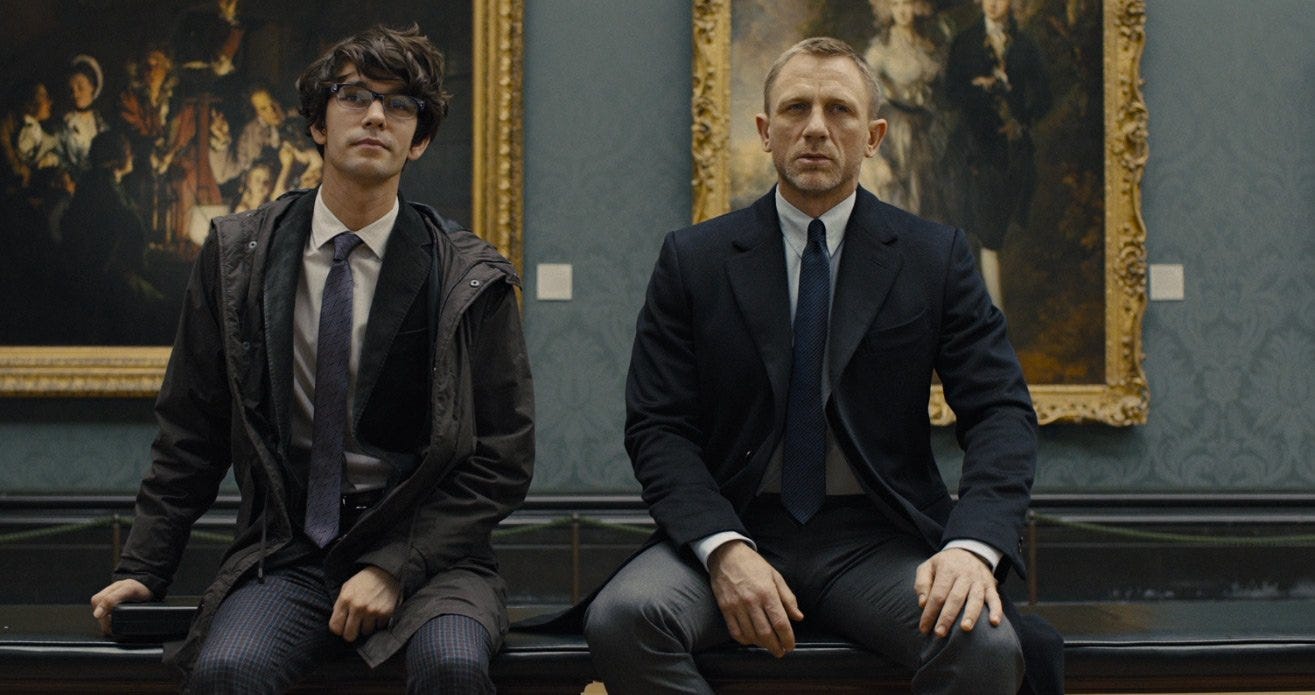
Judgment beyond the algorithm
“Q: I’ll hazard I can do more damage on my laptop sitting in my pajamas before my first cup of Earl Grey than you can do in a year in the field.
BOND: Oh, so why do you need me?
Q: Every now and then, a trigger has to be pulled.
BOND: Or not pulled ... It’s hard to know which in your pajamas.”
The exchange from Skyfall captures something essential about the difference between intellect and judgment, between analysis and decision.
Q stands for the cerebral, data-saturated world of technical mastery, the safety of simulation. Bond embodies the uncertainty of action, where the stakes are indeterminate and hesitation can be fatal. One has knowledge, the other responsibility.
The conversation turns on the space between them, the gap in which human judgment lives.
In Ancient Greece this space had many names. Phronesis for Aristotle, gnōmē for the rhetoricians, metis for Odysseus.
Judgment was not calculation but orientation: the ability to see a situation as it really is, not as one would wish it to be.
Thucydides’ Pericles judged when to fight and when to hold back, knowing there was no formula for either. Greek strategists were obsessed with the indeterminate, with how experience could shape intuition without collapsing it into rule. The general in Herodotus or Xenophon must act under uncertainty, guided by probabilities but never governed by them.
This is the tension our own technological moment has rediscovered.
AI can already pull many triggers. It can optimise, predict, correlate.
But it cannot judge.
It models outcomes within a defined space; it cannot redefine the space itself, which turns out to be the key point.
Inductive inference, the forming of new hypotheses from incomplete experience, remains the most human act of all.
To hypothesize is to imagine what might be true though we cannot yet prove it. It is to proceed as if the unknown can be known, but only by trying. Machines can test hypotheses, but they do not live with their consequences. They cannot feel the weight of choice. For them, that’s just a word, at best.
The Greeks, or any human civilization before or since, knew that strategy was never just about means and ends. It was about how knowledge and doubt coexist in the mind of one who must act.
Judgment, not information, decides whether to pull the trigger or wait, or even to question the premise of the trigger itself.
That remains our fragile advantage. To reason within the fog, to be wrong and learn, to judge and sometimes, mercifully, not to act.


