Late medieval Italian leadership
The Italian city states, in the last centuries of the medieval period, experienced something close to a political explosion. Not war alone - though there was plenty of that - but a frenzy of strategising, alliance-building, a sudden awareness of classical models, a hunger for complex wins.
Florence, Venice, Milan, Siena, Ferrara. Each one a lab. They experimented with political systems, with institutions, with rhetoric, with the rediscovery of antiquity, with political writing as a craft in its own right.
Out of this came humanism, came Machiavelli, came something we might now call complex systems thinking, came a depth of leadership that still hasn’t been fully understood.
There’s something we might call governance through ambiguity.
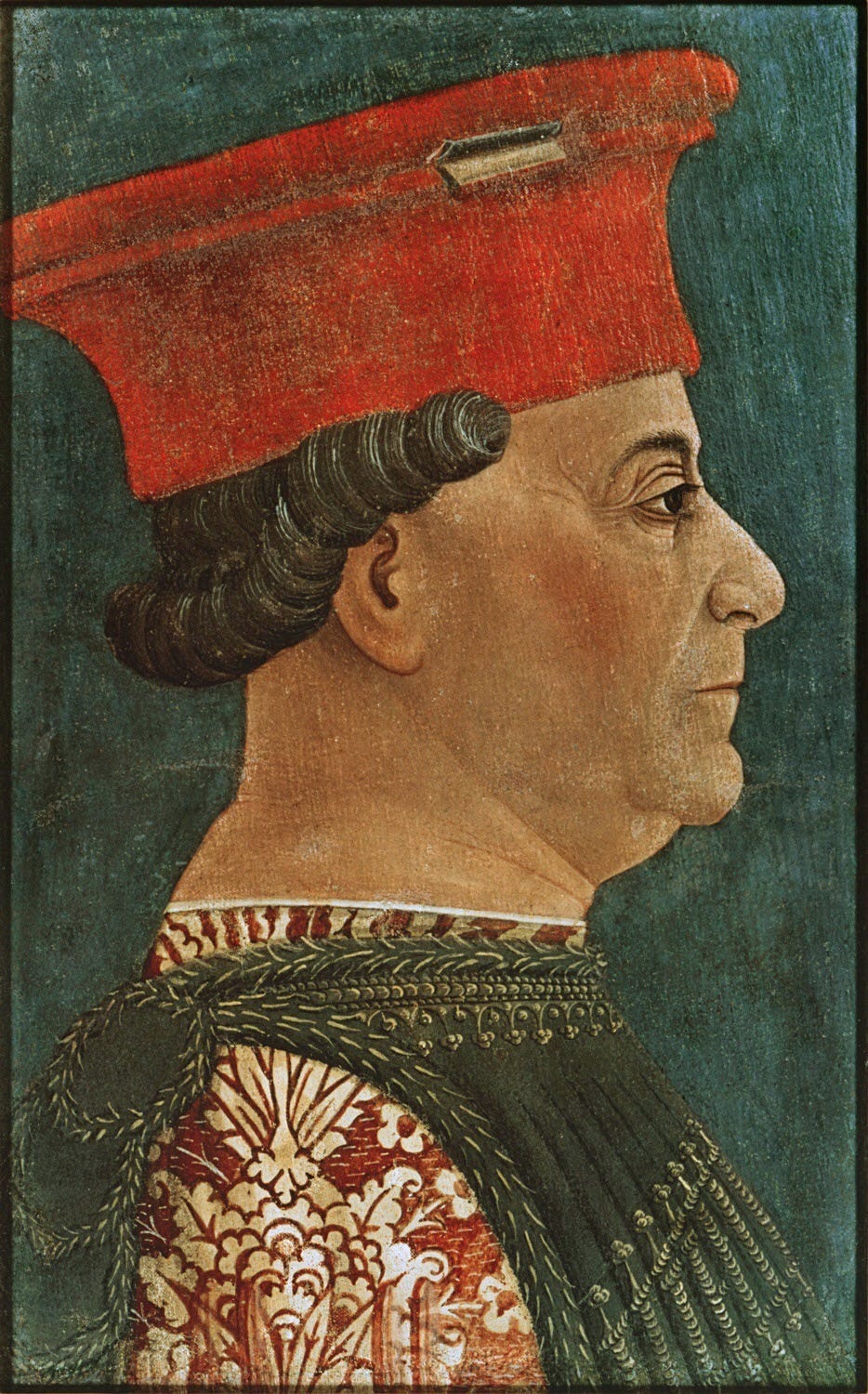
Francesco Sforza of Milan, who seized power in 1450 after years of calculated manoeuvre, built his entire rise on never quite committing, keeping enemies uncertain, allies hopeful, rivals second-guessing. He had spent the previous decade as a condottiere for hire, switching employers with a timing so precise it looked like instinct but was almost certainly arithmetic.
When the Ambrosian Republic collapsed and Milan needed a strongman, Sforza was the only figure positioned on every side at once. Once in power, he governed the same way, making alliance with condottiere Francesco Piccininno one season, threatening him the next, cultivating the Venetians while secretly negotiating with Florence. The structured non-commitment became a recognisable style, almost a school. Half the condottieri of the peninsula learned to read his moves and imitate them.
Then there was something closer to what could be described as networked authority.
Cosimo de’ Medici, the elder, ruled Florence for decades after his return from exile in 1434 without ever formally holding the highest office. He led through relationships, through patronage, always through the slow accumulation of obligation. The Medici bank was the instrument. Branches in London, Bruges, Lyon, Rome, Naples, each one a node in a web of favours and dependencies.
When Cosimo needed a political outcome in Florence, he rarely reached for it directly. He moved through the men who owed him, through the artists he had funded, through the humanists whose libraries he had built. His influence was most powerful precisely when it was least visible. And it wasn’t just him. This model of relational, almost invisible power rippled outward through a generation of Florentine political life that learned to operate the same way. His grandson Lorenzo refined it further still, adding the dimension of cultural celebrity, making the Medici name synonymous with Florence itself.
Venice produced something different and harder to name. Perhaps a kind of distributed, procedural leadership, though even that phrase feels too clean.
The Doge was elected through one of history’s most elaborate procedures: a sequence of lotteries and ballots involving thirty electors chosen by lot from the Great Council, then reduced to nine by lot, then expanded to forty by ballot, then reduced again, on and on through seven stages designed to make capture by any single faction almost mathematically impossible.
Doge Francesco Foscari discovered how thoroughly this system meant what it said when the Council of Ten removed him in 1457 after thirty years in office, his son having been convicted of treason and exiled to Crete. Foscari wept, refused to leave the Doge’s apartments, and died eight days later. The office did not mourn.
What’s striking is how widely this temperament spread through Venetian governance, the habit of deferring to process, of distributing risk across committees and councils, of treating any single leader as temporary and replaceable.
Venetian ambassadors, the most sophisticated diplomatic corps in Europe by the fifteenth century, carried this instinct into every court they visited. Their relazioni (detailed reports on the states they observed) read like systems analyses, interested less in the personality of a prince than in the structures that constrained him.
And finally, something we might call legitimacy as strategy.
Federico da Montefeltro of Urbino, condottiere, collector of manuscripts, patron of Piero della Francesca, dead in 1482, led through the deliberate, patient cultivation of reputation.
Urbino was tiny. Its revenues were modest, its army nothing that Milan or Venice would fear for long. What Federico understood, perhaps more clearly than any of his contemporaries, was that a small state surrounded by larger powers could survive by becoming indispensable to the cultural imagination of the peninsula. He commissioned the Studiolo, an extraordinary inlaid wood room in the Palazzo Ducale where trompe l’oeil bookshelves hold the volumes of an ideal humanist library, less as personal vanity than political argument.
The message was deliberate: here is a ruler who belongs to the ancient tradition of philosopher-kings, whose legitimacy is not merely military but civilisational. He employed Flemish painters alongside Italian ones, built one of the finest libraries in Europe, and received Cristoforo Landino and other leading humanists at his court. Other small rulers watched Urbino and understood that cultural performance was not decoration. It was, as we might say today, load-bearing.


