Medieval mistakes built modern science
We measure the medieval mind by its errors. Four humours governing personality and health. Earth fixed at the cosmos’s center while crystalline spheres carried planets in perfect circles. Vision explained as rays shooting from the eyes to grasp objects in the world.
These theories were spectacularly, magnificently wrong.
Yet dismissing them as primitive fumbling misses the point entirely. Medieval thinkers weren’t foolish, they were necessary.
Their elaborate, wrong-headed theories created the intellectual scaffolding that made disproving them possible, and in doing so, forged the scientific method itself.
Consider Ptolemy’s geocentric model, which dominated astronomy for fifteen centuries. This wasn’t simple-minded Earth-centrism, as is often believed. Ptolemy developed epicycles, deferents, and equants, mathematical machinery of staggering complexity, to predict planetary motion within ten degrees of accuracy.
The system became so intricate, so thoroughly worked out, that when Copernicus and Galileo came along, they inherited not just a theory to demolish but a complete methodology for astronomical prediction. For example, Galileo’s observations of Venus’s phases and Jupiter’s moons didn’t emerge from a vacuum. They emerged because geocentrism had been taken seriously enough, developed rigorously enough, that its predictions could be tested and found wanting. The telescope revealed contradictions precisely because medieval astronomers had specified what ought to be seen.
The same pattern repeats across domains. Humoral theory—the idea that black bile, yellow bile, phlegm, and blood determined temperament and disease—seems absurd now. But medieval physicians systematized observations, catalogued symptoms, developed diagnostic frameworks.
They created an ecology of medical practice: observation, documentation, pattern recognition, intervention. When germ theory arrived, it didn’t start from scratch. It inherited centuries of clinical practice, anatomical knowledge, and the fundamental principle that disease has explicable causes. Wrong causes, yes, but explicable ones that could be investigated.
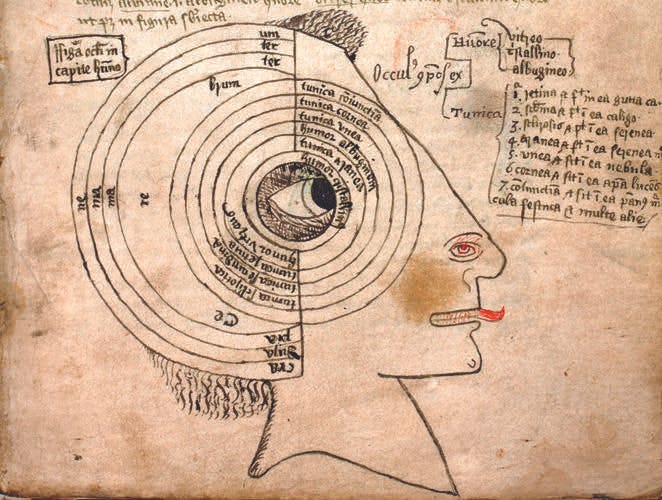
Medieval vision theory, extramission, the notion that eyes emit rays, forced thinkers to grapple with optics, light, perception. Ibn al-Haytham’s eleventh-century experiments disproving extramission and establishing intromission (light entering the eye) emerged directly from sustained engagement with earlier, incorrect models.
Science isn’t merely its findings. It’s method, practice, intellectual culture, the disciplined habit of taking ideas to their logical extremes, testing them against observation, and accepting refutation.
Medieval scholastics, wrong about nearly everything, perfected this habit. They argued, systematized, built theoretical edifices grand enough to be worth demolishing.
Copernicus, Galileo, Harvey, and Newton inherited their rigor. You cannot disprove what hasn’t been thoroughly proved first. You cannot develop instruments to test what hasn’t been predicted. The long centuries of speculative thought weren’t science’s childhood, they were its undergraduate degree.
A paradox then: to reach the higher planes of truthfulness and accuracy, scientific thinking had to walk through the underworld of error and misguided inference, just like Dante had to cover all Inferno first before Paradiso could unfold. And the caution that we might always still be in scientific Hell, with our eyes pinned to the stars.


