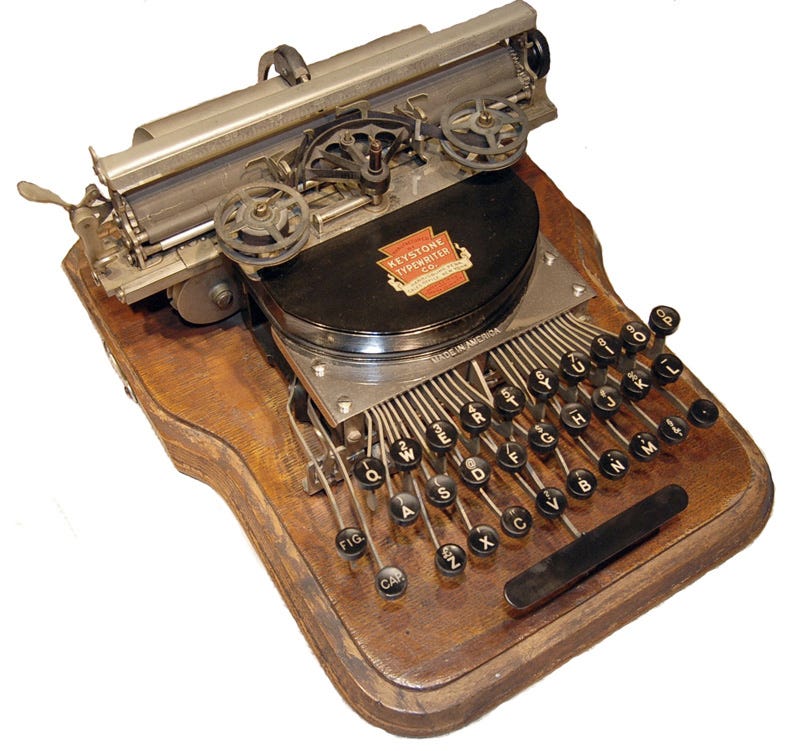
Move slowly and break one fewer things
The typewriter may have been the most paradoxical invention in history. It promised speed: faster writing, faster correspondence, faster commerce.
Clerks could produce more words per minute than any pen allowed. Yet the same mechanism that enabled speed also punished it. Type too quickly on early machines, and the metal typebars, arranged in a basket beneath the paper, would collide and jam. The faster you went, the more likely the system was to seize up entirely.
So Christopher Latham Sholes, patenting his machine in 1868, did something almost nobody had done before in the history of engineering: he deliberately made the interface less efficient in order to make the system more reliable. He studied letter-pair frequencies in English and rearranged the keys so that commonly used combinations sat far apart, forcing the fingers to travel further, slowing the typist down just enough to stop the jams. QWERTY was built to prevent the machine from destroying itself at the speed people actually wanted to type.
This is the automotive equivalent of building an engine capable of 200 kph and installing a governor to cap it at 80, because the roads, tyres and brakes of the era could not survive anything faster. The limitation was the price of survival, and typists adapted, muscle memory calcified, and an entire industry of training, certification and manufacturing grew up around the compromise.
The problem is that the compromise outlived its cause.
Typebars stopped jamming decades ago. Electric typewriters, then computers, then touchscreens removed every mechanical constraint QWERTY was built to manage.
But! the layout remains anyway, sustained purely by switching costs that feel higher than staying costs, even when they are not.
In 1936, August Dvorak designed an alternative layout from scratch, built around efficiency instead of mechanical failure, placing the most common letters on the home row and reducing finger travel dramatically. Later studies confirmed it as faster and less fatiguing than QWERTY once learned. It never gained ground, defeated by training costs and manufacturing habits rather than by merit.
Today’s failure is a failure of an entire species of typists, too comfortable, too habituated, too afraid of a short-term dip in productivity to ask whether the rule still serves the reason it was written.
The keyboard did not fail to evolve. We did.


