Spotty camels and naming things we've never seen before

What does the mind do when it encounters something it has never seen before, not something slightly unfamiliar, not a variation on a known theme, but something genuinely, categorically new?
The brain, it turns out, does not like starting from scratch. There is a word in evolutionary biology, and that’s exaptation. It describes the process by which biological structures get repurposed rather than replaced. The brain never shed its older, reptilian layers when it developed more sophisticated capacities for reasoning and emotion. It built on top of them, recruited them, bent them toward new uses. The architecture is palimpsest all the way down, layered, almost geological, old things doing new jobs.
Language, by way of horror vacui, does exactly the same thing. And nowhere is this more visible than in the frantic, gorgeous mess of naming that happened when European naturalists and explorers began encountering organisms that their entire civilisation had never seen. It doesn’t even have to start in the Age of Exploration, this goes all the way back to the ancients.
What do you do when you meet a giraffe and have no word for it?
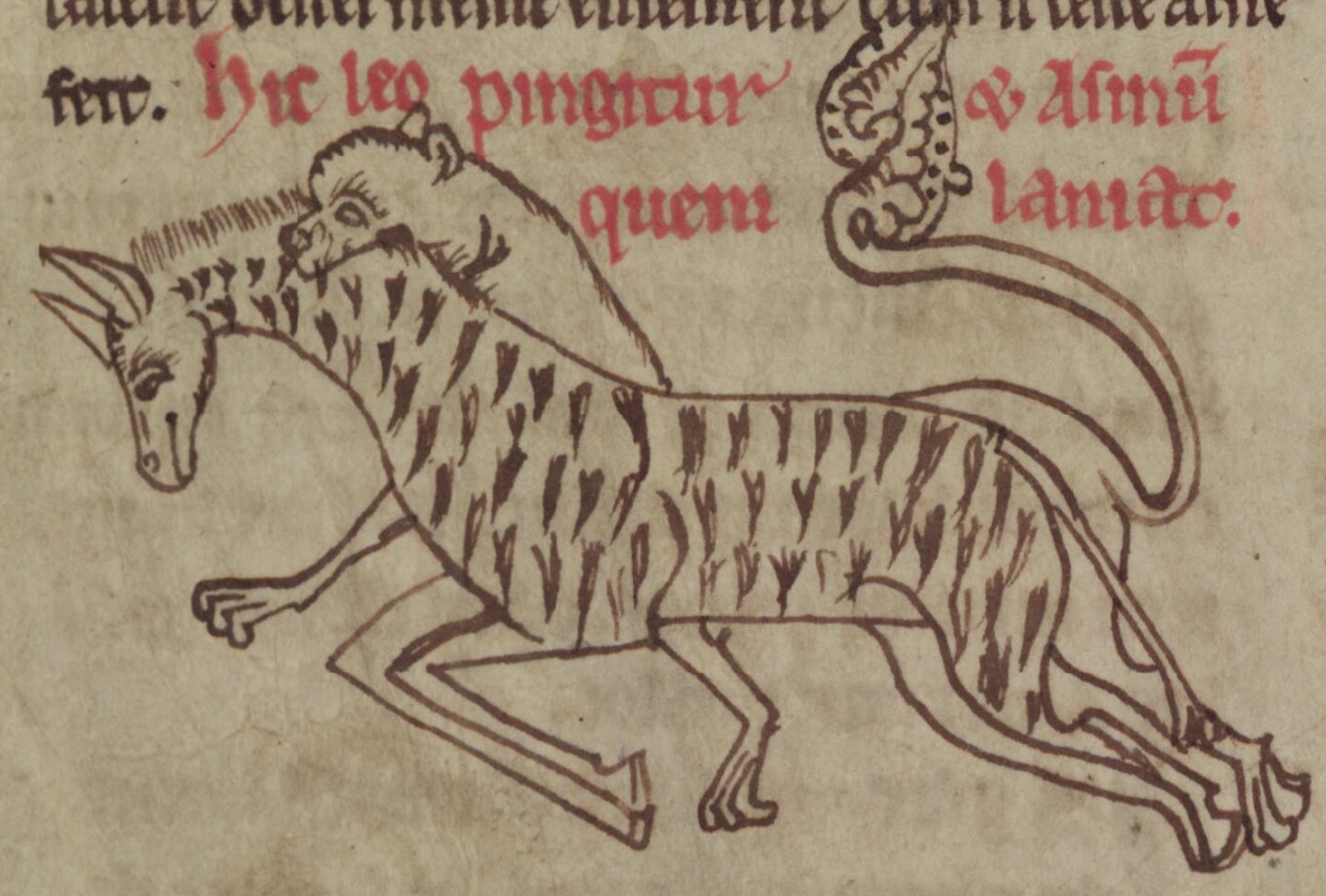
You call it a camel-leopard. The Latin camelopardalis, first mentioned by Pliny, stitches together two familiar animals to gesture at one bewildering one. And the leopard itself, a stitching of lion and pardalis, for spotty, therefore a spotty panther.
The spotty camel is not accurate, exactly. It is approximate. But approximation, it turns out, is almost always good enough, and good enough is what brains and languages have always been optimising for.
The hippopotamus became, in Greek, the river horse, hippos and potamos. The hippocampus, that small seahorse-shaped structure in the brain responsible for memory, carries the same etymological logic.
The naturalists working in this descriptive, analogical mode were doing something deeply cognitive rather than merely administrative. They were triangulating. Locating the unknown by reference to the already known, the way a navigator without instruments uses two visible landmarks to fix an invisible position.
Sometimes the naturalists borrowed directly from indigenous tongues. Jaguar from the Tupi-Guaraní yaguara. Toucan from tucana. Quinine from the Quechua kina, meaning bark. In these moments, there is a kind of intellectual surrender that feels more honest than the Latin compounding, a recognition that people who had lived alongside these organisms for generations had already done the cognitive work. The word arrived already worn in, already fitted to the thing.
Then there were the purely observational names, built from colour or form or behaviour. Rhododendron is simply rose tree. Almost childlike in its literalism. And yet it works. It works because familiarity is not just psychological comfort, but a practical mechanism for adoption.
A word that carries even a fragment of the recognisable travels faster, gets remembered, enters the shared vocabulary with less resistance. Language is, among other things, a social psycho-technology, and these succeed by lowering the cost of entry.
There is a profound conservatism in the face of novelty. A kind of cognitive loyalty to the existing stock of concepts, a preference for extension and recombination over invention. We almost never generate from nothing. We rearrange, compound, borrow, approximate. We let the old absorb the new.
What would a word look like that carried no trace of anything that came before it, that arrived in the mind with no hooks to catch on existing meaning?


