The comfort zone of aporia
We are not good at not knowing. Something in us moves toward conclusions with an urgency that has more to do with relief than with thinking. We confuse commitment with clarity, and non-commitment with failure.
The late Gregory Vlastos, one of the most influential twentieth-century scholars of ancient Greek philosophy, described the Socratic method as “a search for moral truth by adversary argument.” But What tends to go unnoticed is how frequently that search ends without any conclusion at all.
Aporia is the Greek word for that state. It means impasse, or perplexity, or simply being at a loss. It’s one of the many things supposedly intelligent machines are terribly bad at. Sitting in uncertainty is certainly what AI can’t do, at least for now. And it turns out this is not the ultimate goal, but the beginning of wisdom, the starting point of reason.
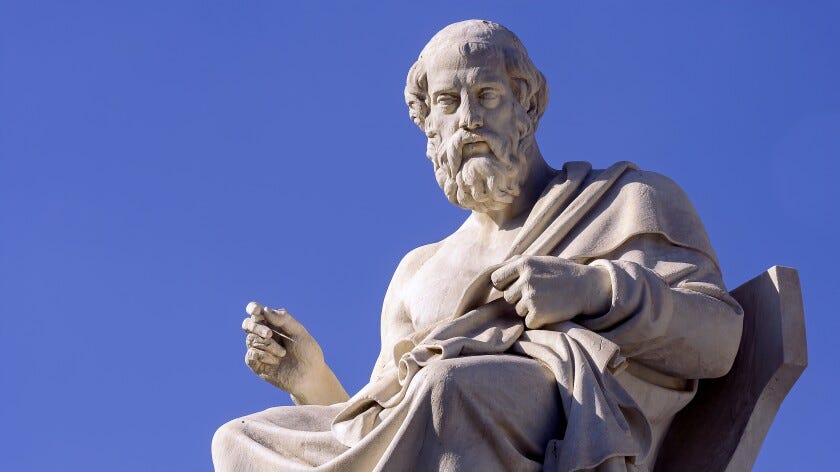
In Plato’s early dialogues, the ones called ‘aporetic’, Socrates asks someone to define a concept. Justice. Courage. Piety. The interlocutor tries. Socrates questions each answer until it falls apart. The dialogue ends with nothing settled. Most readers feel frustrated. That frustration is worth examining.
Philosopher Jan Szaif argues that Plato presents Socratic examination as offering genuine “cognitive and ethical benefits from the otherwise unpleasant experience of intellectual puzzlement, provided that one draws the right conclusions from one’s failure.” (italics mine) Failure, indeed, but not quite what we mean by failure. The apparent failure is doing something. It is clearing away the false impression of knowledge. Finding three things that knowledge is not is, it turns out, a result.
In the Meno, one of Plato’s most readable dialogues, a young man accuses Socrates of being like a torpedo fish, an electric ray that numbs whatever it touches. Socrates accepts the comparison but adjusts it. “I myself do not have the answer when I perplex others,” he says. “I am more perplexed than anyone when I cause perplexity in others.” Aporia is not something Socrates inflicts. It is something he inhabits alongside his interlocutors. Socrate’s goal is to make aporia bearable.
Two thousand years later, aporia still feels unbearable. Our world has been built on anti-aporetic foundations. The anxiety of cognitive uncertainty, forestalling epistemic humility.
This matters because we are extremely prone to what the Oxford philosopher Gilbert Ryle called ‘category mistakes’ or ‘errors’, namely treating things as belonging to a category they do not. Ryle, best known for his critique of Cartesian mind-body dualism, used the term to show how confused thinking can wear the clothes of confident thinking. We mistake having a belief for having knowledge, knowing that for knowing how. We treat genuinely complex problems, where conditions constantly shift and no single solution exists, as though they were merely complicated ones, hard but ultimately tractable. We confuse being with having, adverbs with abstract nouns. We care more about grasping than with becoming.
The Pyrrhonian philosophers of ancient Greece took aporia further still, calling the suspension of judgment epoché, and treating it not as intellectual paralysis but as a route to something like tranquillity. The absence of forced conclusions, they suggested, is freeing rather than distressing. Can we hold a question without trying to close it? Can we acknowledge the limits of our own perception and language without experiencing that acknowledgement as defeat? Can we overcome the anxiety of sitting in uncertainty?
Socrates walked the streets of Athens asking questions he could not answer and meeting people whose views he could not fully share. He waited for the next encounter. And the one after that. Each conversation a chance to be proved wrong, to think differently.


