The cunning intelligence of ancient mêtis
There is no doubt that we are indebted to the ancients, Greeks and Romans first of all, as the vehicles through which the wisdom of the Mediterranean, refined over centuries of experimentation, conflict, consolidation and destruction, were transmitted to us moderns by the post-classic world.
But no matter how strong that heritage may be, and it certainly is, there is so much stuff that didn’t make it into the package that got delivered to our modern doorstep.
In today’s Substack, I’ve got three items of this stuff for you, but I’m only going to focus on the last one. The first ancient idea I want to mention that didn’t quite make it in our modern consciousness was Polybius’ theory of regimes cycle known as ‘anacyclosis’, which debunks both the idea of political ‘evitability’ (that certain forms of government can be avoided) and that of, though unbeknownst to Polybius, progress; the second is oikeiosis (Greek for ‘familiarization’), the Stoic solution to the dilemma of explaining altruism from first principles; and lastly, the “theory” of cunning intelligence known as mêtis. As we’ll see, mêtis is not at all a theory, but it’s becoming almost impossible to talk about something without calling it a theory or a concept these days.
A distinct mode of intelligence in Greek thought, mêtis is best described as flair, opportunism, deception, timing (which the Greeks called kairos), and adaptability, embodied by figures like Odysseus, Hermes, and the octopus, and practiced by helmsmen, hunters, weavers, and politicians.
Mêtis is one of the strangest casualties in the history of Western thought. A fully-formed theory of decision-making that predates Plato, it was actively suppressed by him, and then vanished so thoroughly that only academic scholarship has kept track of it, bringing it back via arcane books and Substacks.
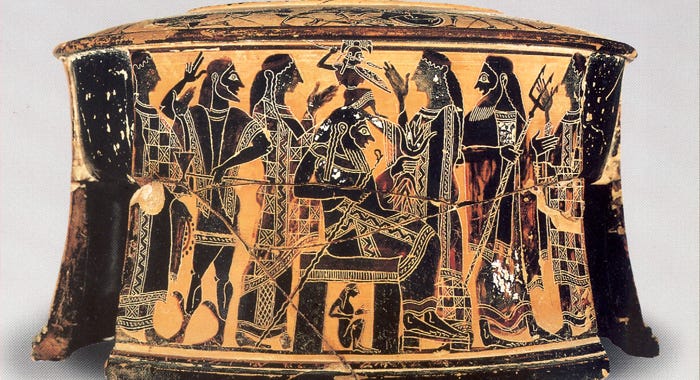
In good archaic tradition, Mêtis was a who before it became a what. Originally a Titan goddess, she was Zeus’s first wife, so the whole thing goes to the very beginning, ab origine, in illo tempore. She was described by Hesiod as wiser than all gods and mortal men.
Fearing a child of hers would overthrow him, Zeus swallowed Metis whole while she was pregnant, absorbing her cunning into himself and later giving birth to Athena from his own head (you can’t make this stuff up). The myth has often been read, since classical times, as an allegory for what happened to the concept itself: raw, embodied cunning gets swallowed and domesticated by the rational, sky-father intelligence that becomes the value pursued by philosophia.
We could say today that mêtis was not a virtue or a piece of knowledge but a whole mode of cognition, built around several core qualities working together: the ability to seize kairos (as I mentioned, the precise, fleeting right moment) rather than follow fixed rules, adaptability and multiplicity, deception and disguise using illusion, masks, and misdirection as legitimate tools of intelligence, and practical embodied skill.
Around the fifth century BC, Greek thought split cognition into episteme (theoretical knowledge, pretty much what modernity packs under the heading ‘knowledge’) and techne (rule-based technical skill, which you have to experience rather than read about). These were categories that we inherited and that could be written down, taught systematically, and verified with logical precision.
Mêtis fit neither.
I’ll leave it up to you to reflect whether mêtis should come back or not.


