The evolutionary selection of literary canons
Some texts survive. Most don’t. The ones that do aren’t always the best, but they are the fittest. Which makes them the best, from a cultural point of view.
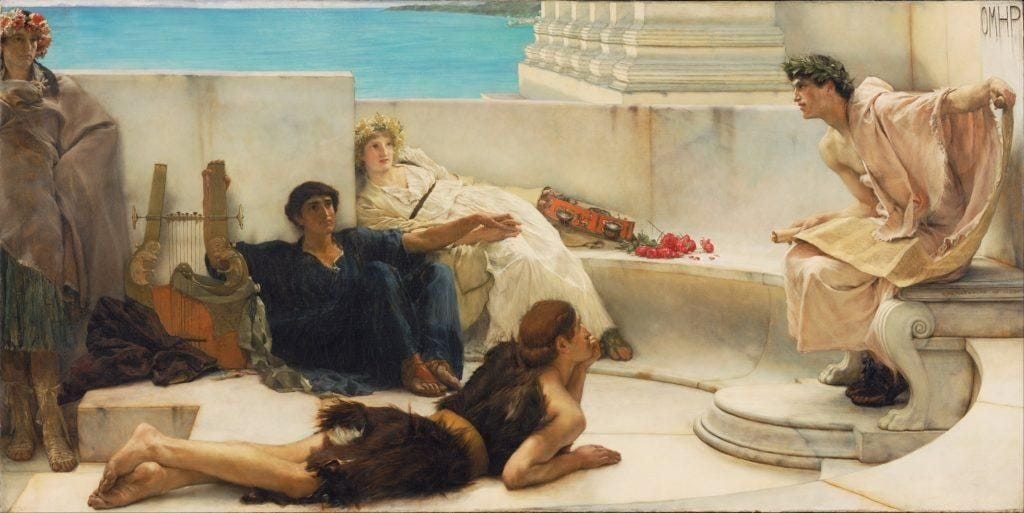
Homer’s Iliad and Odyssey began as oral performances, competing in a crowded ecosystem of epic poetry.
Rival cycles, the Cypria, the Aethiopis, dozens of others, existed alongside them. They’re gone. Homer isn’t. Why?
Partly the stories themselves: war, homecoming, love, identity, the gods behaving badly. These are themes with no expiry date.
But also Athens. When Athenian authorities institutionalised Homeric recitation at the Panathenaic festival in the 6th century BC, they celebrated Homer, yes, but they also replicated him, generation after generation, into the cultural genome.
Alexandria then did what any good conservatory does: it curated, standardised, and exported.
The Library’s scholars fixed the texts, annotated them with extraordinary care, and handed Rome a ready-made literary inheritance.
The Romans, characteristically, didn’t question it. They built on it, first imitating, then outpacing, and finally enshrining.
Virgil understood this. The Aeneid was more than a poem; it was a bid for immortality dressed as a national epic. Within decades of its publication in 19 BC, it had become a school textbook. Children copied it out line by line. Medieval monks quarried it for theological metaphors.
Dante chose Virgil as his guide through Hell not just because he was famous, but because his fame had become self-perpetuating.
Authority citing authority, the oldest intellectual tradition there is.
This is the flywheel of canon formation. A text gains prestige. Prestige attracts institutional support, schools, courts, scriptoria, churches. Institutional support guarantees exposure. Exposure produces more readers, more citations, more prestige. The wheel turns, building on itself.
What sustains the momentum is layered meaning. The Odyssey works simultaneously as adventure narrative, homecoming myth, psychological allegory, and meditation on the divine. Each era finds its own door into the same room.
Medieval readers saw in Odysseus a figure of pietas or curiositas depending on their mood. Renaissance humanists found a model of eloquence and cunning. Modern readers find trauma, displacement, and the unreliable narrator.
The text doesn’t change, its readers do.
Authority-driven cultures, which is to say most cultures for most of history, are almost structurally compelled to preserve whatever prior authorities endorsed.
If Augustine quoted Virgil, Virgil was worth reading. If Chartres built its cathedral school curriculum around classical texts, those were the texts that mattered. The canon wasn’t simply transmitted, it was institutionally insulated from competition. Survival of the fittest text.
And common things stay common longest. Cultural erosion is real, but it is also slow, generational, almost geological.
Homer and Virgil matter far less to a university student today than they did to a Roman schoolboy in the 1st century AD. But they haven’t vanished. Christopher Nolan is launching an Odyssey film. Troy filled cinemas in 2004. The Aeneid remains on syllabuses.
The memory is shallower now, but it is still live, residual, latent, occasionally flaring back into the popular imagination.


