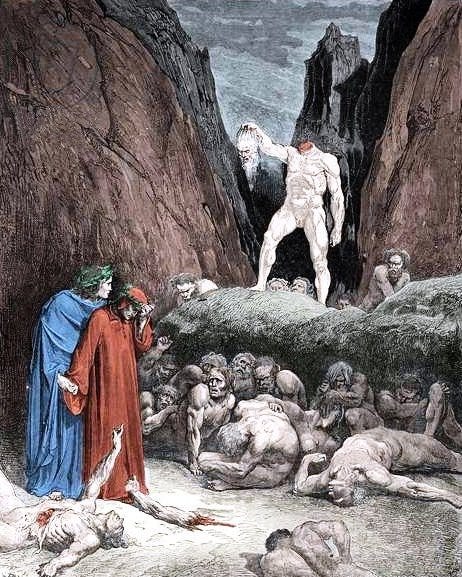
The Lantern Man who cast no light
I surely saw, and it still seems I see,
a trunk without a head that walked just like
the others in that melancholy herd;it carried by the hair its severed head,
which swayed within its hand just like a lantern;
and that head looked at us and said: “Ah me!”Out of itself it made itself a lamp,
and they were two in one and one in two;
how that can be, He knows who so decrees. (Inferno 28, 118-26)
There are moments in literature so strange, so precisely imagined, that you have to stop and simply marvel.
Canto XXVIII of Dante’s Inferno is one of them. Dante is walking through the ninth bolgia — a ditch of schismatics, those who tore apart what was whole — and he sees a figure striding toward him carrying his own severed head by the hair, holding it at arm’s length like a lantern in the dark (a guisa di lanterna). The head swings, looks up, and speaks.
The figure is Bertran de Born, the Limousin troubadour whose verses lit the fire of rebellion between a king and his son. And the image Dante offers is so concentrated, so luminously horrible, that it keeps opening outward the longer I sit with it.
The obvious reading is the contrapasso, the creative tit-for-tat logic of punishment, in Dante’s seismic coinage — he divided father and son, so his head is divided from his body. Justice rendered in flesh. Poetic, and yet more than that.
But something else is happening here that I can’t stop turning over. Bertran is holding his own head out as a source of light. He is illuminating himself, with himself. The lantern he carries has no wick, no oil, no flame from outside. It is just his own face, his own skull, his own proud intelligence suspended in the dark, casting… nothing. This is the man who believed he could see clearly, the Lantern Man. Who trusted his own counsel so completely that he whispered it into the ear of a prince and called the resulting catastrophe truth. And now he walks eternally as a monument to the one thing the self cannot do: shed its own light.
This is not quite solipsism in the philosophical sense, but it rhymes with it deeply. As the phenomenologist Dan Zahavi and others working on self-awareness have noted, the solipsist occupies a position of omnipotent passivity — all-powerful in a virtual world that is, in another sense, no world at all. The solipsist watches herself think. She mistakes the brightness of her own attention for the brightness of the world.
Bertran’s lantern-head is that mistake made flesh: the conviction that the self is the origin of light, rather than one of its conditions.
And this is where predictive processing theory walks unexpectedly into a medieval ditch. Karl Friston, Andy Clark (his new book The Experience Machine is a lantern in the positive sense), and Anil Seth have developed a model of cognition in which the brain is not a passive receiver of reality but an active prediction machine, constantly generating hypotheses about what the world is, then comparing those predictions against incoming sensory signals, and adjusting. The core information flow, as Clark argues, is top-down, not bottom-up. We do not perceive the world and then think. We think, we predict, and then we perceive the difference. What we call seeing is already saturated with prior expectation, with model, with self. Understanding is never a solo act; it is a negotiation between what the mind anticipates and what the world pushes back. Reality is co-constructed at the intersection of brain and world, prediction and error. It is not objective or subjective, but, in the words of John Vervaeke, transjective.
Bertran refused that negotiation. He was a man of such magnificent self-certainty, of such confident political intelligence, that he saw no need for correction. His head, that instrument of prediction and counsel, had become sealed off from the very friction that makes knowledge possible.
And so Dante gives him, for eternity, the image of a mind perfectly and uselessly self-contained: a head that generates its own light and illuminates nothing. The Lantern Man is ridiculous in his self-asserted powerlessness.
The medieval thinkers who shaped Dante (Aquinas, Augustine, Boethius, among others) understood light as always proceeding from something beyond the self. God is the light that is not caused. Everything else participates in light; it does not originate it.
Bertran’s sin, on this reading, is not merely political. It is metaphysical. It is the sin of mistaking participation for origination, of believing that because you can see, the seeing is coming from you. A sin or a metaphysical bias, it belongs to all of us.
The severed head is not punishment only. It is a diagram of an epistemology, an image of what a mind looks like when it has been cut off from the relational ground that makes knowing possible.
What haunts me is that Dante himself was tempted by this. He admired Bertran; he wrote about him with respect in De vulgari eloquentia as a master of martial song. There is something almost confessional in the intensity with which he imagines that swinging, luminous, useless head. A warning to the poet in himself. The mind that believes it makes the light will, eventually, carry only darkness, irredeemably.


