


I love Socrates like a friend, I have been re-reading Plato for years, but if I hear the words ‘Socratic method’ one more time…
What follows is a brief rant-ful monologue on the Socratic dialogues, thank you for your patience a priori.
You don’t need to know about the scholarship fault lines dividing ‘developmentalists’ from ‘unitarians’ when it comes to the question of Plato’s “project”. Socrates didn’t leave anything written, so almost all of Socrates’ method and ‘madness’ is Plato casting/using him in his dialogues. The developmentalists hold that Plato’s thought changed over time. The early dialogues portray the historical Socrates (less cast, less used), and the middle dialogues use “Socrates” as a mouthpiece for Plato’s own metaphysics. In the late phase, Socrates vanishes, and Plato’s dialectic becomes a method in service of developing a metaphysics.
The unitarians, on the other hand, argue that the early dialogues already anticipate the later doctrines, and the dialogues form one single project.
You didn’t need to know that, but now you know.
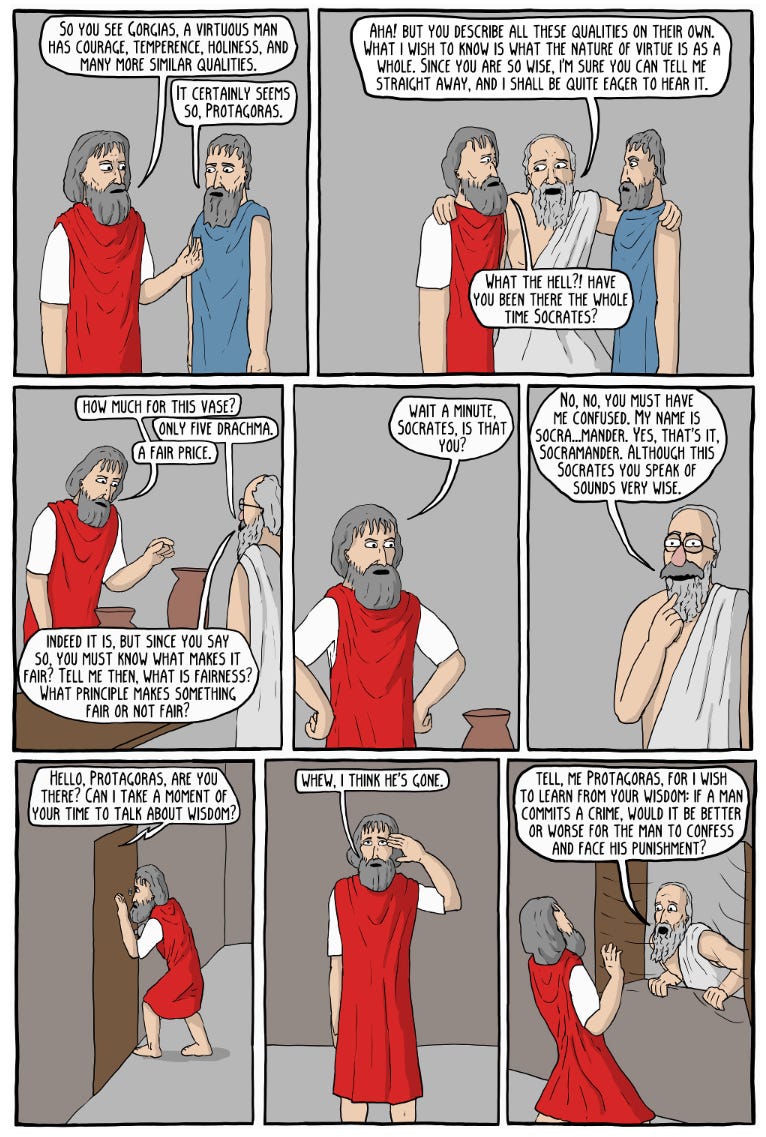
The Socrates we like to quote today is the ‘earlier’ Socrates, the one who likes asking questions like an executive coach or a therapist, the Socrates who avoids committing to definitive positions, who listens, challenges and exposes the interlocutor’s (might we say the client’s?) unexamined assumptions, biases and cognitive fallacies and limits. This is the Socrates of the elenchus, the cross-examination, testing, or refutation approach, and the Socrates of the aporia, the impasse and perplexity, corresponding to the state the interlocutor reaches when elenchus has refuted his thesis and he has no replacement.
Remarkably, this is not the Socrates that allowed Socrates to travel, textually speaking, to the modern period and reach us. For most of the two millennia separating Plato and his Socrates from us, it was the Platonic Socrates whose insights gelled into definitive ideas, views and systems, whether epistemological, as in the Myth of the Cave, or metaphysical, like the Theory of the Forms. The medievals, Byzantines and Arabs who transmitted Plato to us had little patience for elenchus and aporia.
We like the idea of asking questions without judging, and the method has proved extremely practical and useful. But Socrates is more than a coach, and more than a therapist. He’s the pebble in one’s shoe. And when we think we’re comfortable with the ‘Socratic method’, that ‘it makes sense’, that’s when we lose him, since there is nothing comfortable about conversing with Socrates. The Athenians understood this quite well, and couldn’t tolerate him. And we know how it all ended…