The pope, the crossbow and the algorithm
Pope Leo XIV’s recent encyclical on artificial intelligence reads, in places, like a cry from the wilderness. It warns of disruption, of power concentrated in too few hands, of technologies that outpace our moral frameworks. It calls for restraint. It calls for governance. It calls, in its own careful way, for a kind of peace.
Where have I heard this before?
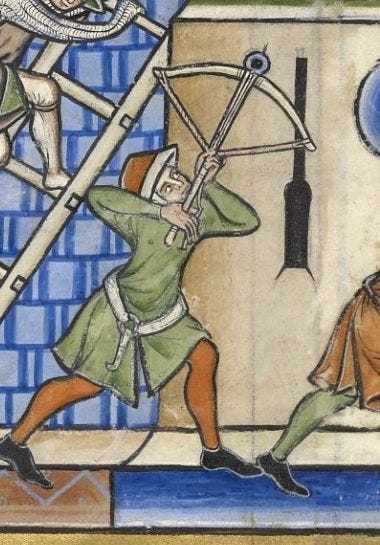
Oh, here it is. In 1139, Pope Innocent II convened the Second Lateran Council, one of the largest assemblies of Church authority in medieval history, and issued Canon 29. The use of crossbowmen and archers against fellow Christians was declared mortiferam et Deo odibilem: deadly, and hateful to God.
A weapon, formally condemned.
The story has lodged itself in popular memory as a tale of papal hubris: the Church banning a new invention because it let peasants kill knights. But this is mythology almost entirely. The crossbow was not new. It had existed in China since at least 600 BC. It had been used in Europe for well over a century before 1139. And Canon 29 banned archers too, in the same breath, the same sentence (ballistariorum et sagittariorum)
What Innocent II was actually doing belonged to the broader Pax Dei movement (the Peace of God), an attempt to limit Christian-on-Christian violence in a world the Church struggled to police. It failed, of course. Richard the Lionheart' was killed by a crossbow bolt sixty years later, while putting down a revolt in the Limousin, not while on Crusade. The irony.
So when Pope Leo XIV looks at AI and sees a threat to human dignity, to the concentration of power, to the social order, he is not wrong to worry. He is simply the latest in a long line of moral authorities watching a technology accelerate beyond the reach of any single institution to contain.
It’s unlikely the encyclical will stop the algorithm, just like Canon 29 didn’t stop the bolt.


