


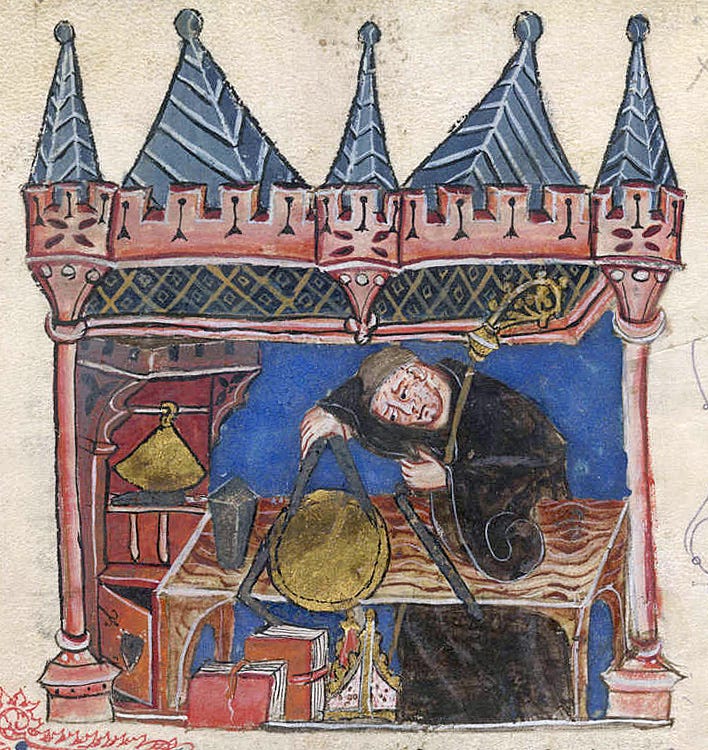
When we talk about AI, we name Turing, Shannon, maybe Leibniz. We rarely look back far enough to meet a monk or a nun in his or her scriptorium.
Just think about what had to survive. Lucretius’s On the Nature of Things reached the Renaissance through a few Carolingian copies. Multiply that across thousands of texts and you get the soil modern science grew in. Redundancy mattered too. A text copied in many monasteries could survive the loss of any one.
Then there was university Latin, the medieval internet protocol. A scholar from Paris and one from Bologna or Cordoba could argue in the same language, and the new universities gave them rooms to do it.
Some of the earliest algorithms were ecclesiastical. Computus, the calculation of Easter, meant reconciling solar and lunar cycles. Bede’s The Reckoning of Time, written in 725 taught generations of monks to run the procedure, and it helped popularise dating by anno Domini, the AD of today. In the 1260s Roger Bacon was already complaining to the pope that the calendar had drifted. The fix only came in 1582...
The sky got the same attention. In 1270s Toledo, scholars working for King Alfonso X produced the Alfonsine Tables, planetary predictions that astronomers used for roughly three centuries, Copernicus included.
In the 1330s the “Oxford Calculators” (people, not machines, such as Heytesbury, Bradwardine, Swineshead) worked out the mean speed theorem, and Oresme drew motion as a graph. The calculus toolkit was being assembled long before anyone named it.
Avicenna imagined a man floating in the void, stripped of every sense, and asked what he would still know of himself. Buridan proposed impetus to explain why arrows keep flying. Albertus Magnus described plants leaf by leaf, and Frederick II corrected Aristotle on falcons. There was wild speculation, but the scientific mindset was there, slowly growing.
Here is the tentative point. Science grew like a complex system: no planner, thousands of nodes, copyists, calendar-keepers, translators and tinkerers, each doing a local job.
Which brings us to the “Dark Ages”, a term I came to loathe so much. Petrarch, and I forgive him, reached for the metaphor in the 1340s, but Voltaire and Gibbon ran with it - they are unforgivable for that.
Judge a system by its peaks and the centuries after Rome look like a trough. Look at the whole network and they look like the period when the wiring was laid: manuscripts copied, monasteries and cathedral schools founded, universities invented around 1200. A relay station that keeps a signal alive belongs to the signal’s story, doesn’t it?
Through a systems lens, we are able to tell a different story.