Time is not given
The history of the 25 of March reveals how creatively we mark the passage of time

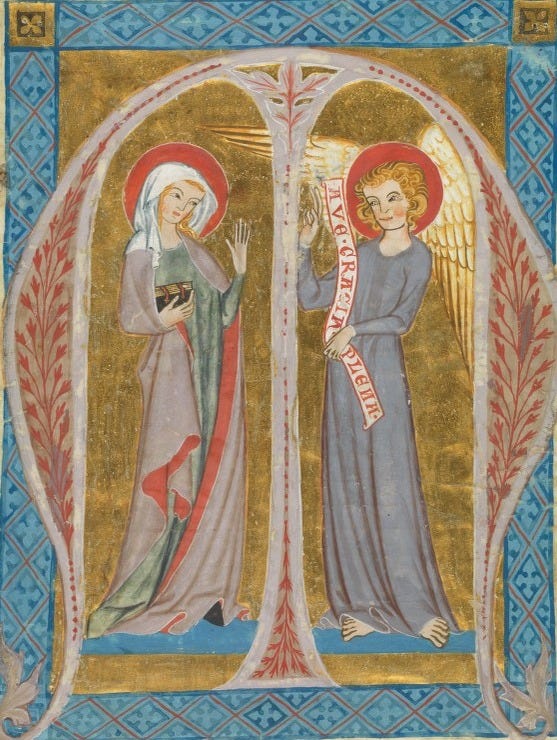
Last Wednesday was the Feast of the Annunciation, the 25th of March, nine months before Christmas. Yesterday the clocks went forward.
Both feel like routine sacred/secular calendar events (depending where you are), and in a way they are, but they are also reminders that the way we divide and label time is not given to us by nature. It is chosen.
And for most of human history, different people chose differently.
For much of medieval Europe, the 25th of March was New Year’s Day. The reasoning was theological: if the Incarnation – God becoming human – was the central event of all history, then the moment of Conception was a meaningful place to begin the year. According to some medieval scholars, it wasn’t only the Annunciation that fell on the 25 March, but also the Crucifixion, the creation of Adam, the fall of Lucifer, the Crossing of the Red Sea and the almost-immolation of Isaac, making the day almost a kind of axis of salvation history.
This system of reckoning the beginning of the New Year, known informally among historians as the ‘Annunciation Style’, or commonly as Lady Day in England, was used across large parts of western Christendom. England used it officially until 1752.
But it was never universal. The Council of Tours in 567 formally condemned the 1st of January as a pagan festival (it had been the Roman new year) and tried to suppress it. That held for a few centuries. By the 1200s, many chroniclers were quietly returning to the Kalends of January, the Roman term for the first of the month, as their working start of year.
Florence began its year on the 25th of March. Pisa also used the Annunciation, but the previous year’s Annunciation, meaning they were a full year behind Florence in their dating. Two cities forty miles apart, numbering the same day differently. Venice started its year on the 1st of March, to make matters worse.
These were not errors. They were features. Deliberate, locally coherent systems that made sense within their own administrative and ecclesiastical contexts. They made less sense at a regional and global level, as a traveller from Venice to Pisa via Florence would’ve experienced.
England adopted the Gregorian calendar in 1752, the reformed calendar introduced by Pope Gregory XIII in 1582 to correct a growing drift between the calendar and the solar year. That’s nearly two centuries late. The reasons were Protestant suspicion of anything from Rome, political inertia, and a reliable English reluctance to follow the Continent’s lead (no B-words here). By the time Britain made the change, it had to drop eleven days from September 1752 to realign, causing genuine popular confusion.
The British tax year still runs from the 6th of April, which is a direct fossil of this history. Lady Day, the old new year, was one of the four quarter days when rents were paid and accounts settled. When the calendar reformed, the 25th of March shifted forward for financial purposes, eventually settling on the 6th of April, where it has remained ever since. Every tax return is, in a small way, an echo of the Annunciation, which, for most people, has more to do with Mary’s anxiety than the joy the Archangel’s news elicited.
If we stop to consider this and clocks changing, and the history of every single point in our calendars, we can appreciate how recent, and how contingent, our shared temporal infrastructure actually is. Time zones are a nineteenth-century invention, created largely because railways needed reliable arrival times. Daylight saving time dates from the First World War. The European Union planed to abolish it in 2019 but DST is still around in the Old World.


