We are all mythophiloi

While Christopher Nolan’s Odyssey is hitting the water next week, a different Christopher has put another vessel in the wake of Odysseus’ crisscrossing nostos (the Greek for ‘return journey’, the root of our word nostalgia).
The French novelist Christophe Ono-dit-Biot has recently published L’odyssée de l’Odyssée: Tout ce que vous avez toujours voulu savoir sur les aventures d’Ulysse sans avoir jamais lu Homère (“The Odyssey of the Odyssey: everything you ever wanted to know about Ulysses’ adventures without having ever read Homer”) - a fascinating book which does more to reveal its author’s sensibilities than to boost interest in the Homeric epic, which has kind of managed to sell itself for the last 3,000 years with little concerted marketing effort…
There are however three things that I’m taking away from Ono-dit-Biot’s book, and arguably insights that I’ve never quite pondered myself before while reading the poem. They might not be the most scholarly of insights, but they are proof that the poem still speaks inexhaustibly loud and clear across generations.
The first is that Homer, whoever he or they were, was a DJ. Like a DJ sampling his way through the night, the poem uses perhaps more repetition than all the vinyls during a set. Through formulas and epithets, the poem keeps the rhythm and beat for over 12,000 lines. Lines that ancient aoidoi, the professional epic poem singers, would’ve easily memorised.
The second, related to the first, is that Homer is a stand-up comedian. The invocation to the Muse to dwell in the aoidos, the voice of the poem, which kickstarts the epic to keep the audience riveted to the narrative is something all too familiar to stand-up comedians. Before an audience of men, women and children, Homer is the voice of and by the fire, improvising, modulating, recursively moving the story forward, using as many narrative devices (distant flashbacks, in medias res, stories within stories, etc) as are humanly possible.
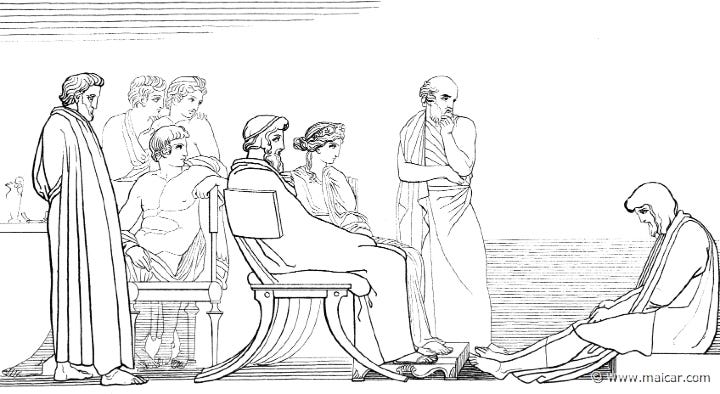
And the third, which appears to have been less Ono-dit-Biot’s original idea than old scholarly speculation, is that Odysseus may have been a bit of a mythomaniac about his adventures. For those who need a bit of brushing-up on the narrative arc of the Odyssey, more than half of the story is told by Odysseus while staying with the Phaeacians on the island of Scheria, a seafaring (=naturally curious and risk-taking) people who had welcomed him after a shipwreck and who can’t have enough of his storytelling. In other words, if polytropos Odysseus, the Odysseus of many turns (and returns), ends up making up many of his stories (especially those about adultery with demigodesses and near-death escapes) like a top mythomaniac, it’s because his listeners are mythophiloi, lovers of stories, narrative junkies as it were.
Like Scheherazade millennia later, storytelling is a survival strategy - not that Odysseus’ life was in danger with the Phaeacians, but he needed their support in getting back to his home in Ithaca. And the stories may have been the exchange currency.


