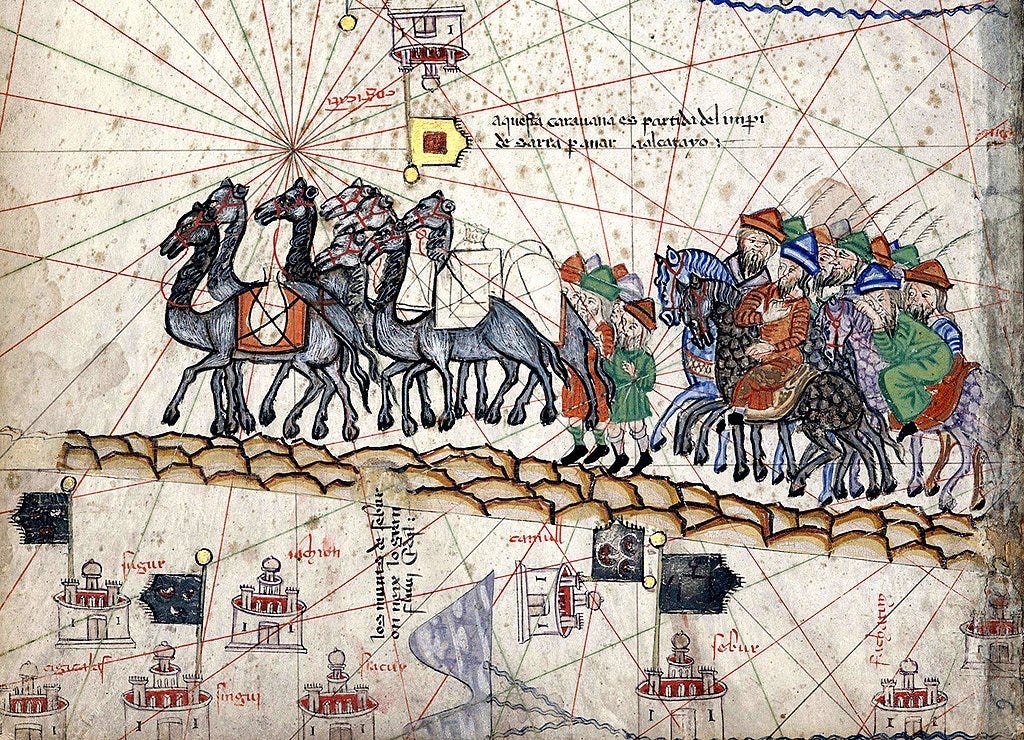
What Marco Polo had and didn't have
No freedom. No notes. No maps. No travel companions to correct his recall. No literary talent. No recent memories. The journeys were decades old. No framework of his own to hold it all together.
Marco Polo left Venice in 1271, aged seventeen, with his father and uncle, both seasoned merchants of the eastern trade. He would not return for 24 years.
He crossed Persia, the high passes of the Pamirs, the killing silence of the Gobi Desert.
He reached Kublai Khan’s court at Shangdu in 1275. He stayed. He served the Khan as an administrator and envoy for seventeen years, governed the city of Yangzhou, witnessed the fall of the last Song strongholds in southern China.
He sailed home from Quanzhou in 1292, threading through the South China Sea, the Strait of Malacca, the Indian Ocean, landing finally at Hormuz, which he found open and geopolitically boring, before the long overland haul back to Venice.
He arrived in 1295, almost unrecognisable, in Mongol dress, speaking Venetian with difficulty. Three years later, fighting for Venice in a naval war against Genoa, he was captured and imprisoned in Genoa.
In the cell next to him was Rustichello da Pisa, a professional writer, also a POW, who had spent his career crafting Arthurian romances for the courts of northern Italy.
Polo had nothing to do but remember. Rustichello had nothing to do but write.
Between 1298 and 1299, Polo dictated. The Livres des Merveilles du Monde, or Il Milione, as it was known in Italian, was the result.
Now consider what he had.
He certainly had time. For the first time in thirty years, no caravan to manage, no Khan to serve, no sea to survive. Just stillness and a man with a pen.
He had Rustichello, who gave the raw torrent of memory a shape Polo could never have imposed himself.
The episodic structure, the formulaic openings, the address to the reader, the framing of each province as a wonder worthy of attentio. Rustichello’s Arthurian mind at work, the only organising intelligence available.
He had memory forged in extremity. You do not forget an audience with the most powerful ruler on earth. You do not forget crossing the Taklamakan, where the desert plays drums and voices at night, as he recalled. You do not forget the pepper markets of Malabar, the gold-roofed temples of Cipangu, the war elephants of Yunnan. The experiences that survived intact across thirty years were the ones burned deepest at the moment of impact.
Memory and wonder share the same psychology. The marvellous is precisely what persists.
He had confinement, which is underrated. No new experience was crowding out the old. The present was minimal. The past expanded to fill it entirely.
And he had imagination. Not modernist invention, but the medieval faculty of image-making, the capacity to reconstruct what the eye had once perceived. Where memory frayed, imagination sutured. The rhinoceros he encountered in Java he called a unicorn. The only category a thirteenth-century Venetian merchant possessed for a creature with a single horn. The new was filed under the nearest available old, as I pointed out elsewhere.
The Milione is a million things, but it is first and foremost what extreme memory looks like when it finally has nowhere else to go.


