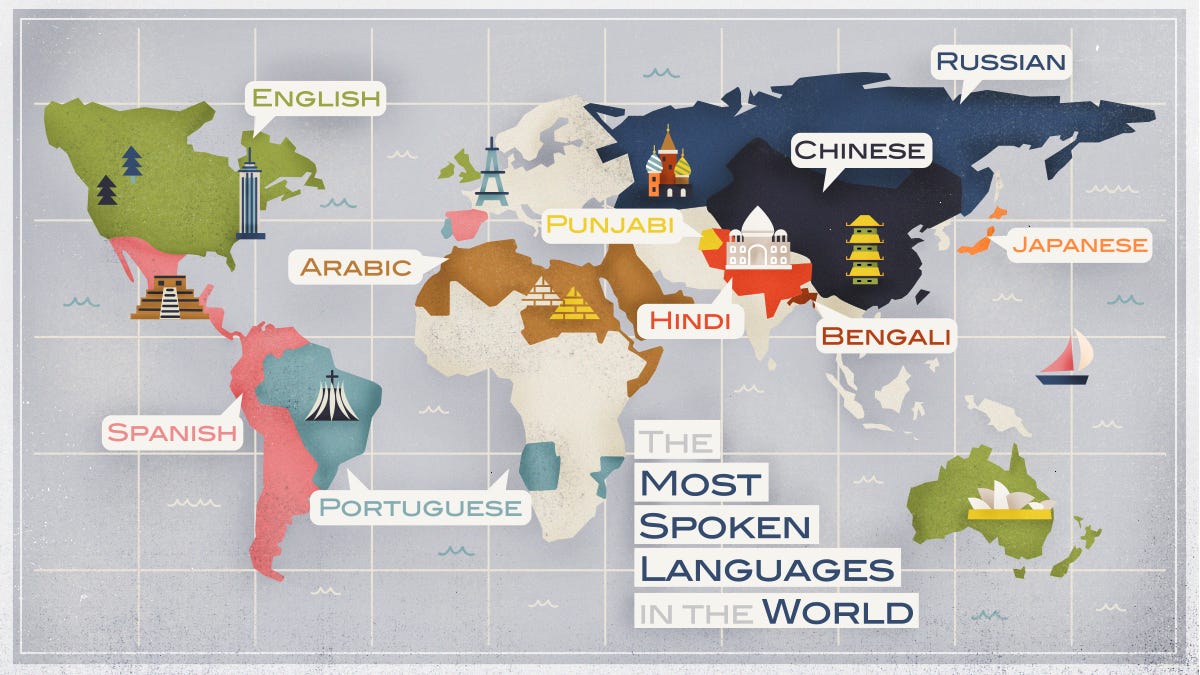
Welcome to another week of Biblonia. Let me kick off with 10 hopefully interesting statistics about the state of languages and their speakers today (with an unavoidable focus on Indo-European ones).
The hardest languages for English speakers take almost four times longer to learn than the easiest ones.
According to the US Foreign Service Institute, the body that trains American diplomats and has taught languages for over 70 years, Arabic, Mandarin, Japanese, and Korean sit in its hardest tier (Category IV) and need roughly 2,200 classroom hours to reach professional fluency. The easiest tier (Category I), needing only about 600 to 750 hours, is made up entirely of Indo-European languages: Spanish, French, Italian, Portuguese, Dutch, and the Scandinavian languages. Indo-European, which includes English, Farsi and Hindi, is the family of related languages that spread across Europe, Iran, and northern India, and later worldwide.
The most grammatically elaborate language ever recorded is not European at all.
I’ve found that Tabasaran, spoken by a small community in Dagestan in the Russian Caucasus, was listed in the 1997 Guinness Book of World Records as having 48 noun cases, meaning 48 different endings a noun can take depending on its role or position in a sentence (English has none, by the way), though some later scholarship revealed that a stricter analysis yields only 14 or 15. Either way, the count dwarfs the six or seven cases found in the most inflected European languages such as Russian and Polish.
373 languages have died out since 1950.
According to Ethnologue, the reference catalogue of the world’s languages published since 1951 and now the standard source for speaker counts, 373 languages have gone extinct since 1950, with a further 424 classed as nearly extinct and 203 as dormant, meaning no fluent speakers remain but a community still identifies with them. Almost none of these losses are European. They fall overwhelmingly on small indigenous communities in the Americas, Australia, and the Pacific.
Whole branches of the linguistic family tree, not just individual languages, are disappearing.
According to a study drawing on both Ethnologue and UNESCO’s Atlas of the World’s Languages in Danger, 15% of the world’s language families have gone completely extinct since 1950, and a further 27% are moribund, meaning no children are learning any member language. Losing a family is more serious than losing a language, because it removes an entire independent lineage of human speech rather than one branch of a surviving tree. The Americas have been hit hardest, then the Pacific, Asia, Africa, and Europe last.
How fast a word changes depends on how often people say it.
According to a 2007 study, everyday words change far more slowly over the centuries than rare ones, which is somewhat counter-intuitive. The reasearchers compared 200 basic meanings across 87 related European and South Asian languages and found that frequency of use accounts for roughly half of all variation in how quickly a word gets replaced. Here’s an example: the number “two” survives in recognisably similar form across the whole family, from Latin duo to German zwei to Sanskrit dvau, while the word for “tail” has been replaced so often that dozens of unrelated forms now exist.
English, Mandarin, Hindi, Spanish, and Arabic are the world’s five great bridge languages.
It’s well known that a lingua franca is a language people use to talk to each other when it is nobody’s mother tongue, and according to Ethnologue’s 2026 figures the biggest is English, with around 1.5 billion total speakers once second-language users are counted. Mandarin Chinese follows, then Hindi at 611 million, Spanish at 561 million, and Arabic. What is striking, though hardly surprising, is that English’s dominance is not about native speakers at all:: most of the people who speak it learned it as a second language. Three of the five (English, Hindi, Spanish) belong to the Indo-European family.
Nearly half of humanity speaks an Indo-European language as a mother tongue.
According to Ethnologue’s data, around 46% of the world’s population, roughly 3.2 billion people, has an Indo-European language as their first language. The family covers most of Europe plus Iran and northern India, so it takes in English, Spanish, Portuguese, Russian, German, French, Greek, Persian, Hindi-Urdu, Bengali, and Punjabi, among many others. No other family comes close on speaker numbers. You can guess why.
The Indo-European family of languages has about 445 living members, but the bulk of them are small Indian and Iranian languages.
There are roughly 445 living Indo-European languages, of which 313, more than two thirds, belong to the Indo-Iranian branch spoken across Iran, Pakistan, India, and Bangladesh.
Six families out of well over a hundred account for 87% of all speakers.
According to an analysis of Ethnologue data by linguists writing at Humans Who Read Grammars, six language families cover about 5.9 billion people, or 87% of the world’s population, even though linguists count somewhere between 141 and 260 families in total.
There are roughly 7,000 living languages, and only about 6% of them are Indo-European.
Definitions vary, but the world currently has somewhere between 7,000 and 7,200 living languages. This figure shifts slightly each year as dialects get reclassified as separate languages or merged back together. The Indo-European family accounts for only around 6% of that total! There’s the Pareto Principle for you…


