You write the book you need to read
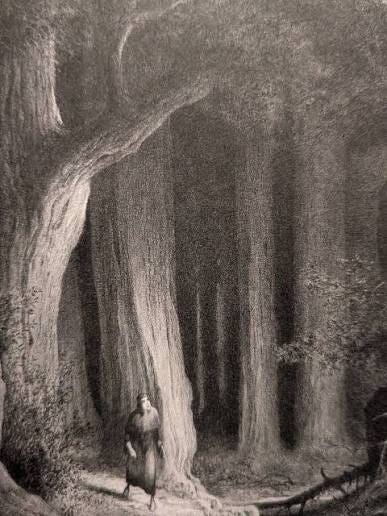
Nel mezzo del camin di nostra vita. In the middle. Not the beginning, not the end. The middle is the hardest place to be, because you can see both directions and feel certain of neither.
Dante was lost. Not metaphorically lost in the way we say casually. Lost in the way that a man who has watched his city betray him, his beloved die young, his political dreams collapse into exile, can be lost. The selva oscura was real. The darkness had a texture.
So he wrote the book he needed to read.
The Commedia works on us across centuries precisely because it was never written for us. It was written for one man trying to find his way. That intimacy is what we feel. The lifeworld Dante constructs, every shade in the Inferno, every terrace of the Purgatorio, every radiant intelligence in the Paradiso, is saturated with his obsessions, his grievances, his loves, his intellectual furniture.
It is Dante-centric in the way that only a man saving his own soul can be Dante-centric.
Three things happened in that poema that Dante, alone with his thoughts, could never have given himself.
He was proved wrong. Again and again, the voices he encounters in the afterlife refuse his categories. Francesca da Rimini makes him weep when his theology says he should not. He swoons, caddi come corpo morto cade, he falls like a dead body falls. The pilgrim’s sympathies are constantly outrunning his doctrine. The souls he expected to despise teach him something his pride had sealed off. The journey corrects him.
No man can correct himself with sufficient ferocity; you need a Virgil, you need the encounter with the other, you need to be shown where your certainties have calcified into self-deception.
He was shown what he could not show himself. Virgil takes him where reason can reach, but reason has limits, non è il voler nostro, our will is not enough. The architecture of the Inferno, those graduated circles of consequence, gives Dante a cosmology for what suffering means, for, say, why the cold treacheries of the ninth circle feel worse than the hot passions of the second.
He needed to see the moral order laid out spatially, visibly, so that he could feel, not just argue, that his life had a shape.
Maps of meaning. You cannot draw your own map of meaning when you are lost inside the territory.
And then, transcendence.
L.A. Paul writes about transformative experience, the kind of experience that doesn’t just update your beliefs but changes who you are, changes what you are capable of wanting. You cannot know what it will be like from the outside. You can only undergo it, and you must.
Dante’s Paradiso is precisely this. The luce etterna, the vision of God at the poem’s end, O luce etterna che sola in te sidi, is not a doctrine proved but a self remade.
Dante the pilgrim arrives at the final canto a different being than Dante who woke in the dark wood. The transformative experience Paul describes is irreversible; it forecloses the person you were before.
The book he needed to read. The things he needed to hear. The things he needed to see.


