The threshold of textual reproduction
We tend to imagine the loss of ancient literature as catastrophe, dramatic and violent. Libraries engulfed in flames, fanatical monks shredding the works of Plato.
The evidence for this is thin.
What actually happened was far more mundane and far more consequential. People simply didn’t bother copying things down. Hardly the stuff of Netflix.
The numbers are sobering. Of 772 known classical Latin authors, not a single word survives from 276 of them. Fragments alone remain for 352 more. Only 144 have at least one surviving work. All extant pagan classical texts would fit into roughly a thousand scrolls, perhaps about 5% of what the largest Roman libraries held. The Great Library of Alexandria alone is said to have contained 40,000 scrolls. What we have is a residue, alas, not a canon chosen by scholars. It is instead a canon chosen by tired men in cold rooms deciding what was worth their time.
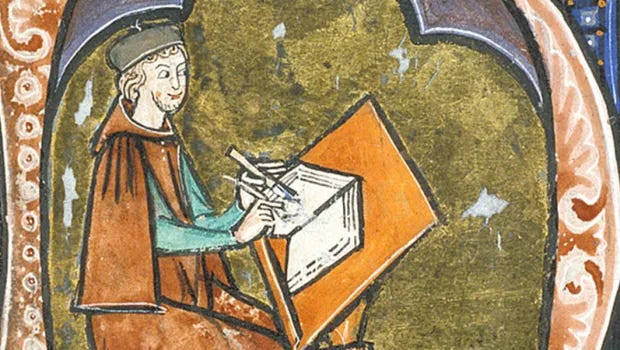
The institutional machinery for these decisions was the scriptorium, operating under abbatial authority. The abbot and senior ecclesiastical figures set the agenda. Texts needed copying before the originals, usually fragile papyrus, not durable parchment, disintegrated.
An experienced scribe could manage around 3.5 leaves, or 7 pages, per day. Parchment was expensive, time was scarce, and the alpha-and-omega question was always: does this serve the community, the liturgy, the curriculum?
Virgil survived because he was the grammar school poet. Cicero survived because about a third of extant classical Latin is his work alone, and rhetoricians found him useful. Menander did not survive in the manuscript tradition at all; his Greek was everyday rather than Attic, stylistically beneath the threshold of the Byzantine copyists who preserved Homer, Plato, and Aristotle with real enthusiasm.
Deliberate destruction is a different, rarer story. The Theodosian Code mandated destruction of certain heretical Christian writings. Pope Leo the Great ordered Manichean texts burned in Rome. Porphyry’s Against the Christians, a formidable Neoplatonist polemic, was condemned in the fourth and fifth centuries. These are real exceptions, not the rule.
The rule was indifference, not hostility. A big yawn rather than a torch.
The model that did possess something like the “librarian instinct”, the idea that preservation has value independent of utility, was Hellenistic. Alexandria under the Ptolemies collected systematically, across languages and disciplines, with an acquisitive institutional energy that had no real parallel until the early modern period.
The medieval monastery operated by opposite logic. The relevant test was present usefulness and ecclesiastical endorsement, not archival completeness.
Language made selection worse. After the fourth century, Greek died out entirely in Western Europe. A monk who could not read a text had no way to evaluate it, and no reason to reproduce it. This is why almost no Greek scientific tradition passed directly through the Latin West, it had to be re-imported via Arabic translation in the High Middle Ages and via exiled Byzantium in the 15th century. The loss wasn’t targeted. It was structural.
Our own age presents a different kind of selectivity.
Mass printing and digital preservation have made total extinction nearly impossible; a work with even 50 surviving copies across institutional repositories is functionally immortal in a way no classical manuscript ever was.
But algorithmic distribution, streaming economies, and citation metrics produce something functionally equivalent to the abbot’s priorities: works are reproduced, recommended, and kept alive in proportion to demand and institutional endorsement.
The long tail exists, but it requires energy, such as editorial attention, server maintenance, or digitization budgets, and these are not infinite.
The difference is that we have lowered the floor for extinction, not eliminated it.
What the medieval period did was apply a very high threshold to what warranted the enormous cost of reproduction.
Works that cleared that threshold, theological authority, classical prestige, educational utility, survived. Everything else needed luck. And occasionally, we’ve been quite lucky. Overall, however, not so much, but it could have always been worse.


